The best cheap car speakers make everyday listening more enjoyable without turning a simple upgrade into a complete audio rebuild. If you are shopping for car speakers under $100, start with the correct size, mounting depth and electrical compatibility. A well-matched pair matters more than the largest peak-wattage figure on the box.
For the separate electrical-supply question in a car-audio build, compare Car Audio Batteries for the Money; a speaker upgrade alone does not establish a battery requirement.

These six models offer different approaches to an affordable upgrade. The Rockford Fosgate R165X3 is the overall pick for its straightforward 4-ohm design, integrated crossover and practical factory-replacement format. The selection includes older models as well as the current Pioneer TS-A1671F; prices and availability vary, so the budget range is a shopping target rather than a fixed price for every pair.
6 Best Cheap Car Speakers
Rockford Fosgate R165X3 (Editor’s Choice)
The Rockford Fosgate R165X3 is a sensible starting point for replacing tired factory speakers. Its 6.5-inch, three-way coaxial layout puts the woofer, midrange and tweeter together, avoiding the extra mounting work of a separate component set. The combination of a polypropylene cone, rubber surround and stamped-steel basket favors a straightforward, durable-feeling design over elaborate styling.
Rockford rates each speaker at 45 watts RMS with a 4-ohm nominal impedance and 91 dB sensitivity measured at 1 watt/1 meter. Those figures make it relevant to a modest car-audio system, while the integrated high-pass crossover keeps the installation tidy. Grilles and mounting hardware are included, which is useful when the speakers will be exposed rather than hidden behind factory trim.
The R165X3 is not a shortcut to subwoofer bass, and a three-way label alone does not make it better than every two-way design. Its 2.15-inch mounting depth also needs checking against the door cavity and window mechanism. Within those limits, it earns the overall pick for its uncomplicated specification and practical approach to an everyday upgrade.
Pros
- Straightforward 4-ohm, three-way coaxial design.
- Polypropylene cone, rubber surround and integrated crossover.
- Grilles and mounting hardware included.
Cons
- Will not replace a subwoofer for deep bass.
- Mounting depth and vehicle-specific adapters still need checking.
JBL GTO638

The JBL GTO638 offers a more unusual electrical design than most of the 4-ohm speakers here. Its nominal impedance is 2 ohms, paired with JBL’s Plus One woofer-cone design to make effective use of the available cone area. That can make it an interesting option for a suitable system, but the amplifier or head unit must support the load.
The GTO638 is a three-way coaxial speaker, with a main tweeter and a separate super tweeter mounted above the woofer. JBL’s model-specific brochure lists 60 watts RMS and 180 watts peak per speaker. Its Intermount III mounting system is intended to accommodate several common 6.5-inch mounting patterns.
The appeal is the combination of that larger effective cone area and a compact all-in-one layout. The compromise is that its low-impedance design deserves more attention than a simple size match. JBL’s “True 4 Ohm” wording does not change the stated 2-ohm nominal specification. For an owner already using this older model, correct system matching matters more than treating a sensitivity number as a guarantee of distortion-free sound.
Pros
- Plus One woofer design increases effective cone area.
- Three-way layout with a separate super tweeter.
- Intermount III mounting arrangement.
Cons
- 2-ohm nominal impedance requires a compatible amplifier or head unit.
- Older model with more limited availability.
Pioneer TS-A1676R

The Pioneer TS-A1676R takes the traditional three-way route, adding a dedicated midrange driver and a small tweeter above the main woofer. Its multilayer mica-matrix cone and elastic polymer surround make it an appealing older option for someone who wants a conventional door-speaker upgrade without mounting separate tweeters around the cabin.
The TS-A1676R is specified at 50 watts RMS per speaker, with a 320-watt peak rating. The continuous figure is the useful starting point when matching an amplifier; the larger number is not a promise that a factory radio will deliver that output. Its 4-ohm impedance also makes it a different electrical proposition from the 2-ohm JBL GTO638.
Its relatively shallow 1.75-inch top-mount depth is attractive where door clearance is tight, although the mounting hole and grille clearance still need measuring. It is an older model, and a current Pioneer with a similar-looking name can have different depth, cone construction and power handling. Compare the exact mounting dimensions when considering a current A-Series alternative.
Pros
- Three-way layout includes a dedicated midrange driver.
- Mica-matrix woofer with an elastic polymer surround.
- Relatively shallow published top-mount depth.
Cons
- Older model with limited availability.
- Similar Pioneer model names do not establish identical fit or specifications.
Kicker 40CS654

The Kicker 40CS654 CS65 is a practical two-way alternative for a system that may eventually gain an external amplifier. Its 6.5-inch polypropylene woofer is paired with a small PEI balanced-dome tweeter, keeping the high-frequency driver within the main speaker assembly. The polyester-foam surround and included grilles complete a conventional, easy-to-understand design.
Kicker’s CS65 specification gives 100 watts RMS and 300 watts peak per speaker, with 90 dB sensitivity at 1 watt/1 meter. That higher continuous rating gives it more amplifier-matching headroom than the smaller-rated JVC, but it does not make it automatically louder on a weak factory radio. Power handling describes what the speaker is designed to accept, not power that it generates.
The flush tweeter arrangement helps avoid a protruding central pod, which can be useful behind factory grilles. The tweeter is fixed, however, so this is not a component system that allows the high-frequency driver to be positioned separately. Expect a normal door speaker’s limits in deep bass, and choose it for its simple layout and amplifier headroom rather than an exaggerated peak-power claim.
Pros
- 100-watt RMS rating provides useful amplifier-matching headroom.
- Compact two-way coaxial arrangement with a flush tweeter.
- Polypropylene cone and included grilles.
Cons
- Fixed tweeter cannot be positioned separately.
- Higher power handling does not guarantee more output from a factory radio.
JVC CS-J620

The JVC CS-J620 is the most modestly rated option here, and that can suit a simple replacement project. Its 6.5-inch mica-cone woofer, rubber-and-cloth hybrid surround and 1-inch PEI tweeter form a straightforward two-way coaxial speaker. It is an appealing format for restoring everyday listening without planning an elaborate amplified system.
JVC specifies 30 watts RMS, a 4-ohm nominal impedance and 92 dB sensitivity at 1 watt/1 meter. The advertised 300-watt peak number should not be confused with continuous handling. A 43 mm mounting depth is also useful to know when comparing it with deeper speakers, though an adapter ring or wiring harness may still be needed for a particular vehicle.
The compromise is its lower continuous power rating if a more powerful amplifier is part of the plan. Its published frequency range also does not mean that a small door speaker will reproduce deep bass with the authority of a subwoofer. For a compatible car and sensible listening levels, the CS-J620’s appeal is its uncomplicated construction and relatively shallow fit.
Pros
- Relatively shallow 43 mm mounting depth.
- Mica woofer, hybrid surround and PEI tweeter.
- Straightforward 4-ohm design for a modest system.
Cons
- 30-watt RMS rating limits amplifier matching.
- Published frequency extension does not imply subwoofer-level bass.
Pioneer TS-A1671F
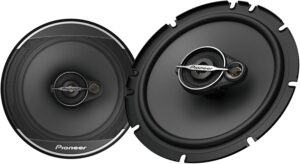
The current Pioneer TS-A1671F is worth considering when an older A-Series model is difficult to source. It is a distinct 6.5-inch, three-way coaxial design with a carbon-and-mica-reinforced IMPP woofer, a dedicated 1.63-inch midrange and an 11 mm PET hard-dome tweeter. The separate drivers give it a clear role as a full-range door-speaker upgrade without requiring a component installation.
Pioneer specifies 70 watts nominal power, a 4-ohm impedance and 91 dB sensitivity at 1 watt/1 meter. The included Multi-Fit adapters help with installation in supported openings, while grilles provide an option for exposed mounting. These are useful, concrete benefits for a budget build that may start with an aftermarket receiver and gain an amplifier later.
The main catch is depth: the published mounting depth is about 2.38 inches, so this should not be treated as a drop-in dimensional equivalent to the shallower TS-A1676R. Check the door cavity and window travel before committing. For a suitable opening, it provides a current, well-documented alternative with greater nominal power handling, while still leaving deep-bass duties to an appropriate subwoofer.
Pros
- Current three-way design with a reinforced IMPP woofer.
- 70-watt nominal rating and 4-ohm impedance.
- Multi-Fit adapters and grilles included.
Cons
- Deeper than the older TS-A1676R.
- Adapters do not guarantee fit in every vehicle.
Do I Need New Car Speakers?
New speakers are worthwhile when the originals are damaged, sound muffled or no longer suit the system. They will not repair a clipping amplifier, poor wiring or a loose door panel. Identify the weak point first: a correctly installed, modest speaker can be more satisfying than a more expensive pair mounted into a rattling door.
How to Pick the Best Car Speakers if You’re on a Budget
Include any adapters, wiring harnesses and installation work in the budget. Measure the opening, depth and grille clearance, and check whether a factory premium-audio system uses unusual impedance or processing. The speaker diameter on its own is not a fit guarantee.
Coaxial vs. Component Car Speakers
Coaxial speakers combine the drivers in one assembly and are commonly described as full-range speakers. Those are not opposing categories. A component speaker system separates the woofer and tweeter, often with an external crossover, allowing more control over placement at the cost of additional installation work. Two-way versus three-way describes the driver arrangement, not a universal quality ranking.
Power Rating
Compare continuous or RMS power handling in watts with the amplifier’s suitable continuous output. A frequency-response specification in hertz describes a different characteristic. Peak ratings are not the same as continuous ratings, and a high-rated speaker does not create extra amplifier power.
Sensitivity
Sensitivity indicates output for a stated test input. Compare the measurement method as well as the number: 2.83 volts is not the same power into 2 ohms as into 4 ohms. A high sensitivity rating is not a limiter that prevents the radio from clipping, nor is 90 dB a universal pass/fail threshold.
Wide Frequency Range
A published frequency range is useful context, but it does not show how evenly a speaker plays across that range in your door. Installation, sealing and the vehicle’s acoustics affect the result. For strong low bass, plan an appropriate subwoofer rather than expecting a small coaxial speaker to do every job.
Distortion-Free Sound
No cone material guarantees distortion-free output at every volume. Keep the amplifier within its clean operating range, secure the speakers properly and use appropriate filtering. If the receiver is another weak point, the flip-out car stereo guide covers a different part of the system.
So, What Are the Best Budget Car Speakers?
The Rockford Fosgate R165X3 is the overall pick for a straightforward, compatible factory-speaker replacement. The JVC CS-J620 suits a modest system with limited mounting depth, while the Kicker 40CS654 has more continuous power-handling headroom. The current Pioneer TS-A1671F is a useful alternative for a suitable deeper opening. Choose the pair that fits the car and the amplifier, then give the installation the attention it deserves.