The best car audio batteries provide energy storage that suits the system, the vehicle and the available space. A small auxiliary battery near the amplifiers serves a different purpose from a full-size starting battery. Adding capacity can support an installation, but it does not increase the alternator’s output or guarantee hours of engine-off listening.
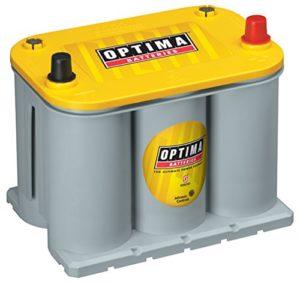
These four AGM options cover different needs. The Kinetik HC600-BLU remains the overall pick for a compact auxiliary installation, while the larger HC2000-BLU offers substantially more rated capacity. The Optima YELLOWTOP D35 shown above is a dual-purpose starting/deep-cycle option for a compatible vehicle. Choose the battery’s role first, then compare capacity, terminals and fit.
4 Best Car Audio Batteries
| Image | Model | Price |
|---|---|---|
 | Kinetik HC600-BLU (Editor's Choice) | Check Price |
 | Sound Quest SQB2000 | Check Price |
| Optima YELLOWTOP D35 | Check Price |
 | Kinetik HC2000-BLU | Check Price |
Kinetik HC600-BLU (Editor’s Choice)
The Kinetik HC600-BLU earns its place through a genuinely compact footprint. At roughly 7.13 by 3.01 by 6.57 inches and about 12 pounds, it is much easier to accommodate than a full-size audio battery. That makes it appealing when the aim is an auxiliary power cell in a space-conscious installation rather than replacing the vehicle’s main starting battery.
Kinetik specifies a nominal 12 volts, 18 Ah capacity at the 20-hour rate and 6 mm threaded terminals. Its AGM construction immobilizes the electrolyte in glass matting and avoids routine water top-ups. The threaded connections are a practical detail to plan around: the correct cable lugs, terminal protection and secure mounting matter as much as finding somewhere the case will fit.
The trade-off is capacity. An 18 Ah battery is not a large reserve for prolonged engine-off listening. It also should not be assumed to meet a vehicle’s starting specification. For a modest auxiliary installation where size is the priority, however, its small case and straightforward connections make a persuasive combination.
Pros
- Narrow footprint and roughly 12-pound weight.
- 18 Ah nominal capacity and 6 mm threaded terminals.
- AGM design requires no routine water top-ups.
Cons
- Limited capacity for prolonged engine-off listening.
- Not a universal replacement for a vehicle’s starting battery.
Sound Quest SQB2000
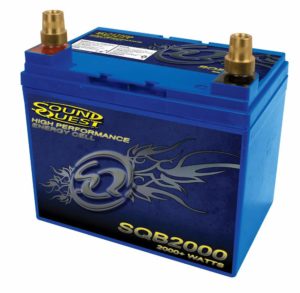
The Sound Quest SQB2000 occupies a useful middle ground between a small power cell and a large auxiliary battery. Its published 33 Ah capacity gives it a different role from the smaller HC600, while the removable brass posts provide a conventional connection option. It is an appealing format when a compact audio installation can accommodate a somewhat broader case.
Sound Quest’s catalog lists dimensions of about 7.72 by 5.16 by 6.10 inches and a 525-amp, five-second burst rating. That burst figure describes a short discharge event; it is not a cold-cranking-amp rating or a measure of stored energy. The useful features for comparison are the rated capacity, AGM construction, terminal arrangement and the space needed for a protected installation.
Its 2000-watt branding is an application claim rather than a promise to run a 2000-watt load for a particular time. It also does not establish that the SQB2000 can replace the vehicle’s starter battery. Choose it for an appropriately designed auxiliary system, particularly when its capacity and removable-post arrangement are a better fit than the HC600’s smaller case.
Pros
- 33 Ah published capacity.
- Removable brass battery posts.
- Relatively compact AGM format for an auxiliary installation.
Cons
- Five-second burst rating should not be treated as CCA.
- Case is wider than the HC600 and still needs a secure mounting location.
Optima YELLOWTOP D35
The Optima YELLOWTOP D35 is the most clearly automotive starting-oriented option here. It is a dual-purpose AGM battery intended to combine engine-starting ability with repeated accessory use, making it relevant when a compatible vehicle needs one main battery to serve both roles. Its SPIRALCELL construction uses tightly wound cells rather than conventional flat plates.
The D35 specification lists 48 Ah capacity, 620 cold-cranking amps and 100 minutes of reserve capacity under the stated test conditions. Those are more useful reference points than a broad audio-wattage label. Group 35 sizing and SAE posts provide familiar automotive mounting and connection features, but the vehicle’s required dimensions, polarity, hold-down and charging requirements still determine whether it is suitable.
The compromise is that this is a full automotive battery, not a small power cell to tuck into any convenient space. For the right application, its combination of a defined starting rating and deep-cycle capability is the main attraction. Vehicles used only occasionally still need suitable charging and storage care.
Pros
- Dual-purpose starting and deep-cycle design.
- Published 48 Ah, 620 CCA and 100-minute reserve specifications.
- Group 35 format with SAE automotive posts.
Cons
- Requires the correct vehicle fit, polarity and charging compatibility.
- Larger and heavier than a small auxiliary power cell.
Kinetik HC2000-BLU
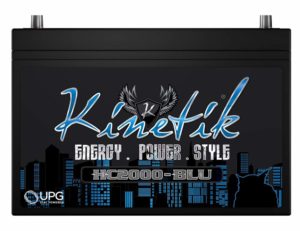
The Kinetik HC2000-BLU is the capacity-focused choice for an installation with room for a substantial auxiliary battery. Its published 90 Ah rating is a major step up from the HC600’s 18 Ah, making it relevant when stored energy is more important than a minimal footprint. The AGM format also avoids the routine water maintenance of a serviceable flooded battery.
Kinetik lists a case around 12.05 by 6.61 by 8.19 inches, a weight of approximately 59.5 pounds and 3/8-inch threaded terminals. Those dimensions and connections deserve planning before purchase: this is a sizable component, not a direct substitute for the smaller Kinetik simply because both use the BLU name.
The extra capacity brings extra weight and a greater charging demand after use. Planning the charging system and cable layout is particularly important when adding a battery of this size. It is most attractive as part of a properly designed higher-capacity audio supply, with the mounting, fusing and charging arrangement chosen for the actual vehicle.
Pros
- 90 Ah published capacity at the 20-hour rate.
- 3/8-inch threaded terminals.
- AGM construction without routine water top-ups.
Cons
- Nearly 60 pounds and a substantial mounting footprint.
- Additional storage still needs an adequate charging system.
How to Pick the Best Car Audio Battery
Decide whether the battery will replace the main starting battery or supplement it. AGM is a type of valve-regulated lead-acid battery, not a separate chemistry from lead-acid. Its low-maintenance design is useful, but the complete installation must still suit the vehicle, charging system and expected audio load.
Choose a Battery in Good Condition
Storage conditions and state of charge matter as well as the manufacturing date. A date alone does not prove that a battery is healthy or unusable. Follow the manufacturer’s charging and storage guidance, inspect the case and terminals, and use a suitable battery test when condition is uncertain. Recycle the old battery through an appropriate collection service.
Size and Installation
Check dimensions, terminal type, polarity, hold-down and cable clearance. A compact auxiliary cell is not automatically suitable as a starter battery. Additional batteries also require an appropriate charging, isolation and fused-wiring arrangement; have the installation designed by a competent car-audio or automotive electrical specialist.
Sealed AGM does not mean gas-free or safe in any orientation. Overcharging can open the safety valves and release flammable gas. Follow the manufacturer’s mounting, ventilation and charging instructions, protect the terminals and secure the battery. Do not add water to these sealed batteries.
Capacity, Reserve Capacity and Cold-Cranking Amps
Amp-hours describe capacity at a stated discharge rate. CCA describes a cold starting test, while a five-second burst rating describes a different short-duration load. Reserve capacity is another standardized discharge measurement. None is interchangeable with the amplifier’s advertised wattage, and none alone predicts listening time with the engine off.
Estimate the actual electrical load and charging balance rather than matching two large watt numbers on packaging. A battery stores energy; the alternator must replenish it. Additional capacity cannot supply more average energy indefinitely than the charging system can replace.
The Warranty
Read the current warranty for the exact battery, seller and intended use. Purchase records, correct installation and suitable charging can matter. “Maintenance-free” means no routine water top-ups, not freedom from charging, inspections or storage care.
Price and Your Budget
Compare the installed cost, including cables, fuses, mounting hardware and any charging changes. A smaller battery may be the sensible choice for limited space, while a larger one may provide more useful reserve for a different system. Paying for capacity that cannot be mounted or recharged properly is poor value.
For vehicle-specific starting-battery choices, see the guides for the C5 Corvette, C6 Corvette, 6.7-liter Cummins and Toyota Tacoma. This VRLA battery overview explains the underlying lead-acid designs.
So, What’s the Best Car Audio Battery?
The Kinetik HC600-BLU remains the pick for a compact auxiliary installation where space and weight matter. The SQB2000 offers a larger rated capacity in a relatively compact case, and the HC2000-BLU is the substantial-capacity option. For a compatible main starting-battery replacement with accessory use, the Optima YELLOWTOP D35 is the more relevant type. The right choice depends on the battery’s role and the complete electrical system, not a wattage label alone.