Are you looking for the best DA sanders? These five dual action and random orbital sanders cover air-powered, corded and cordless options, with different strengths for workshop and home projects.
A DA sander combines orbital movement with pad rotation to help avoid the repeated scratch pattern of a simple orbital tool. The finished surface still depends on the abrasive, pad, extraction and technique; no sander guarantees a mark-free result on every material.
Compare the best 5 DA sanders below, starting with the power source and equipment each one needs.
Top 5 Best DA Sanders
TCP Global SA7336 DA Sander (Editor’s Choice)
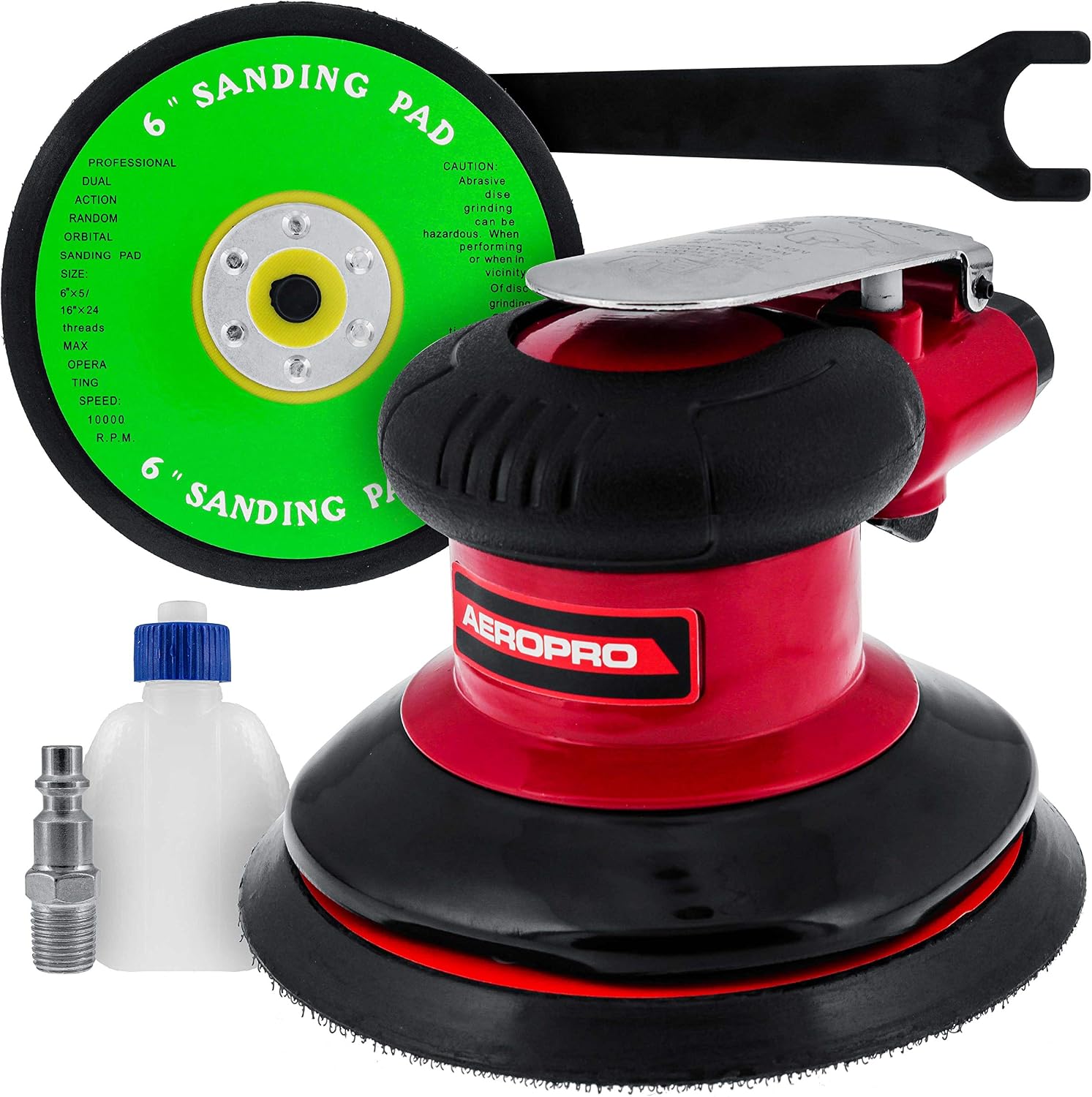
The TCP Global SA7336 remains the overall pick for a workshop that already has a suitable compressed-air supply. Its useful advantage is the pair of 6-inch backing pads: one accepts PSA adhesive discs and the other takes hook-and-loop abrasives, so the tool can work with either attachment style.
Features
The palm-grip design includes an air regulator for speed adjustment. TCP lists a 10,000 RPM free speed, 90 PSI operating pressure and 4.5 CFM air consumption. The quoted speed is an unloaded specification, not a promise of the same pad movement under sanding pressure. The included wrench makes backing-pad changes practical.
The air supply is the main commitment. A compact sander can still need a substantial compressor and hose, and the regulator does not make it silent or vibration-free. Choose the SA7336 for its two-pad flexibility and straightforward air-powered operation; a cordless tool is the easier route when a compressor is not already available.
Pros
- Both PSA and hook-and-loop 6-inch backing pads
- Built-in air regulation for speed adjustment
- Palm-grip format with a supplied pad-change wrench
Cons
- Requires a suitable compressor and air hose
- Air hose can restrict movement around the workpiece
Ingersoll Rand 4151-5 Orbital Sander

The Ingersoll Rand 4151-5 is the more focused choice when a compatible dust-extraction setup is already part of the workshop. Its vacuum-ready design gives sanding dust a route away from the pad, rather than relying entirely on cleanup after the work is finished.
Features
This exact model uses a 5-inch pad, a 3/16-inch orbit and a listed 12,000 RPM free speed. The manufacturer specifies a vinyl pad face for PSA abrasives; it should not be confused with the separate hook-and-loop variants in the same family. At about 1.92 pounds, it keeps the tool itself compact, although the air and extraction hoses still affect handling.
Vacuum-ready does not mean that a vacuum is included or that every hose connects without an adapter. It also remains an air tool, so both compressor capacity and extraction compatibility matter. Choose it for a planned dust-control system, not for a blanket promise of a completely dust-free or swirl-free finish.
Pros
- Vacuum-ready design for compatible extraction equipment
- 5-inch PSA pad with a specified 3/16-inch orbit
- Compact tool with a listed weight of about 1.92 pounds
Cons
- Needs both compressed air and suitable extraction connections
- Standard pad is PSA rather than hook and loop
Gedu GAOA124-1-US Air Sander

The Gedu GAOA124-1-US is a straightforward 5-inch pneumatic palm sander with a hook-and-loop pad. That attachment style is its main practical attraction: discs can be changed quickly as the job progresses through different grits, without peeling an adhesive disc from the backing pad each time.
Features
The model has rear exhaust and a built-in speed regulator. Gedu lists a 12,000 RPM free speed, a ¼-inch air inlet and a 90 PSI operating pressure. The compact palm format is useful for surface preparation where a larger handled sander would be awkward, but it does not remove the need for the correct abrasive and controlled pressure.
The trade-off is the supporting equipment. It needs a capable compressed-air supply, and the published airflow figure should be checked against the compressor’s actual delivery at working pressure. The regulator adjusts speed; it is not a dust extractor or a guarantee of silent operation. Choose it when a small hook-and-loop air sander fits the existing setup.
Pros
- 5-inch hook-and-loop pad for convenient disc changes
- Built-in speed regulator
- Compact palm format with rear exhaust
Cons
- Requires a suitable compressed-air supply
- No integrated dust-extraction system specified
PORTER-CABLE 7346SP Sander/Polisher

The PORTER-CABLE 7346SP is the corded alternative for sanding and polishing automotive or marine projects. Its longer body and removable side handle offer a different grip from the pneumatic palm tools, which can be useful when guiding a 6-inch sanding or polishing pad over a broad panel.
Features
The 4.5-amp AC motor has an electronic speed dial covering 2,500–6,800 orbits per minute. The kit includes a PSA sanding pad, sanding disc and polishing pad, while the side handle can be mounted on either side. Its counterbalance is designed for the specified 6-inch pad format, rather than arbitrary larger accessories.
The roughly 6-pound tool is heavier than the air sanders here, and the power cord still needs managing. Its lower numerical speed range does not by itself make it a worse sander: orbit, pad and application are different variables. Choose it for a corded sanding/polishing setup without a compressor, using the appropriate pad and abrasive for each task.
Pros
- Runs from mains power without a compressor
- Variable 2,500–6,800 OPM control
- Sanding and polishing attachments with a two-position side handle
Cons
- Heavier than the compact pneumatic models
- Cord and larger body can be awkward in confined areas
DEWALT DCW211B (Best Cordless Option)
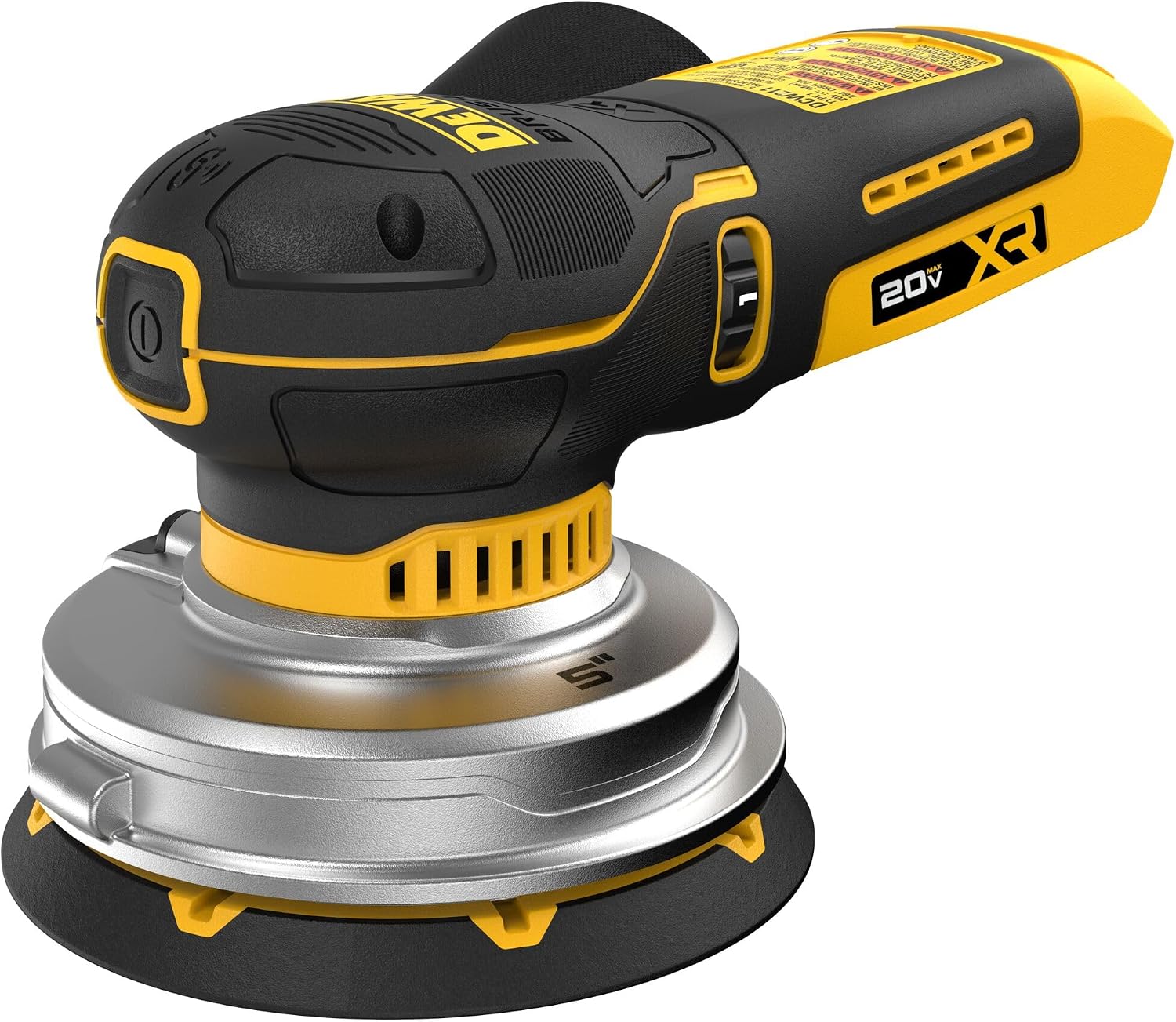
The DEWALT DCW211B is the most convenient choice here when freedom from an air hose or power cord matters. This current 20V MAX XR model combines a brushless motor with a low-profile 5-inch sanding head, making it a useful option for furniture, cabinets and other surface-preparation work away from a fixed air supply.
Features
Five speed settings cover 8,000–12,000 no-load OPM. The AirLock dust port connects to compatible extraction equipment, and integrated Wireless Tool Control can start a compatible vacuum without a separate walk to its switch. The supplied dust bag provides another collection option when the application and material permit it.
The cordless format shifts the compromise to batteries: this DCW211B is the bare tool, so a compatible battery and charger are needed. It is a sander rather than a substitute for the PORTER-CABLE’s polishing setup. Choose it for mobility and modern dust-extraction controls, while treating runtime and collection performance as dependent on the actual job.
Pros
- Cordless brushless design with five speed settings
- AirLock port and Wireless Tool Control for compatible extraction
- Low-profile 5-inch head
Cons
- Battery and charger are separate for this bare-tool model
- Runtime depends on the battery, material and workload
How to Pick the Best DA Sander
Choose for the material, finish and equipment available. A compact tool with the wrong pad or an undersized air supply can be less useful than a simpler setup that suits the job.
Type of Sander
Pneumatic Sanders
Air tools keep the motor in a compact body and can suit a workshop with an existing compressor. Check the tool’s consumption and the compressor’s delivered airflow at the required pressure, not just tank size or peak horsepower. Hoses, air treatment and the tool’s lubrication requirements are part of the setup.
Electric Sanders
Corded tools avoid the need for a compressor and provide power without waiting for a battery to recharge. Cordless tools improve mobility but add battery weight and runtime limits. Neither power source is automatically restricted to hobbyists or professionals; choose by workload and access.
Size of Disc Pad
Pad diameter and orbit diameter are separate specifications. A larger pad covers more area, but it does not automatically have a larger orbit or produce a finer finish. Match the abrasive size, hole pattern and pad rating to the tool.
Type of Disc Pad
PSA pads accept adhesive-backed abrasives; hook-and-loop pads use matching reusable attachment surfaces. Hook and loop makes grit changes convenient, while PSA can be useful in an established shop system. Dust-extraction holes must also line up where the setup requires them.
Ergonomics
Consider the tool with its hoses, cord or battery attached. Palm tools can be easy to guide, while a side handle may offer more control over a larger pad. Published vibration and noise figures depend on the model and test conditions; avoid treating “low vibration” as “no vibration.”
Build and Dust Control
Check replacement-pad availability, maintenance instructions and the extraction connection before buying. A dust bag, vacuum-ready port and complete extractor system are different things. Follow the tool and abrasive manufacturers’ guidance for the material, including suitable dust collection and personal protection.
Which DA Sander Should You Choose?
The TCP Global SA7336 remains the overall recommendation for a suitably equipped air-powered workshop because it supports both PSA and hook-and-loop 6-inch discs. The Ingersoll Rand suits a compatible extraction setup, while the Gedu is a compact 5-inch hook-and-loop option.
For an electric sander, the PORTER-CABLE provides a corded sanding/polishing setup and the DEWALT DCW211B offers cordless mobility with modern extraction controls. Choose the tool that fits the actual task and existing equipment, rather than expecting one sander to excel at every kind of finishing.