The best battery for Toyota Tacoma is the one that matches the truck’s battery group, terminal layout and electrical demands. A stock pickup mainly needs dependable starting power; extra lighting, a winch or an audio system also make reserve capacity and rechargeability worth considering. The five AGM options below serve specific older Tacoma applications, with different installation requirements.
For suspension rather than battery replacement on a Tacoma, use our separate guide to shocks for the Toyota Tacoma and check the model-year and drivetrain requirements.

The Optima D27F is the overall pick for its supported V6 applications, combining starting power with cycling capability. The compact XS Power D1200 needs the appropriate post adapters and mounting work for a Group 35 installation. The 24F and 34R options have their own size and hold-down requirements. These are not universal replacements for 2024-onward trucks, which use different H6/H7 applications. Table sizes are length × width × height in inches; adapters can change the installed height.
The 5 Best Batteries for Toyota Tacoma
| Image | Model | CCA | Size | Price |
|---|---|---|---|---|
| XS Power D1200 | 651 | 7.80 × 6.54 × 6.69 | Check Price |
 | Optima D27F (Editor's Choice) | 830 | 12.16 × 6.76 × 8.61 | Check Price |
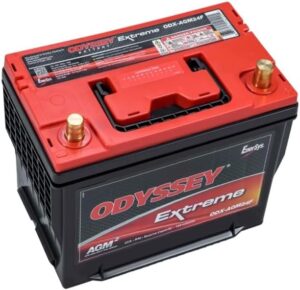 | Odyssey ODX-AGM24F | 840 | 10.9 × 6.8 × 8.8 | Check Price |
 | Odyssey ODX-AGM34R | 850 | 10.9 × 6.8 × 7.9 | Check Price |
 | Deka 9A34R AGM | 750 | 10.75 × 6.875 × 7.75 | Check Price |
XS Power D1200
The XS Power D1200 is the compact, accessory-focused choice in this comparison. Its 55 Ah AGM design suits an installation where space is tight and the electrical system is being planned around the battery, rather than a routine swap with a full-size factory unit. At about 35.3 pounds, it is lighter than the larger AGM batteries listed here.
XS Power specifies 651 cold-cranking amps and 95 minutes of reserve capacity. The M6 terminals accept bolted connections, while ordinary clamp-style battery cables need suitable post adapters. For a Group 35 replacement, XS Power pairs the D1200 with its 586 brass posts and rates the installation as requiring small adjustments or modifications. That makes it relevant to the appropriate older Tacoma setup, but not an exact drop-in replacement.
The appeal is concentrated power in a small case, particularly for a carefully installed audio or accessory upgrade. The trade-offs are the mounting work and less reserve capacity than the larger Optima and Odyssey options here. Keep the battery securely restrained and use the specified AGM charging limits. Choose it when the compact format is part of the plan, rather than expecting the included M6 hardware to solve every factory cable and hold-down requirement.
Pros
- Compact 55 Ah AGM design at about 35.3 lb.
- 651 CCA and 95-minute reserve rating.
- M6 terminals suit a planned bolted-cable installation.
Cons
- Group 35 use needs suitable post adapters and mounting adjustments.
- Less reserve capacity than the larger batteries here.
Optima D27F (Editor’s Choice)
The Optima D27F YELLOWTOP is the strongest all-round recommendation here for a Tacoma V6 application that accepts this battery. Optima specifically identifies it as a direct-fit option for the 2012 4.0-liter truck, with other years depending on the vehicle application. It combines 830 cold-cranking amps with a 66 Ah capacity and 140-minute reserve rating.
The useful distinction is its dual-purpose design: it provides starting power while also being intended for repeated accessory-related discharge and recharge. Optima’s SpiralCell construction holds the electrolyte in absorbent glass mat separators around spiral-wound plates. That makes the D27F particularly relevant when a compatible Tacoma runs equipment such as additional lighting or an aftermarket stereo, rather than serving only as a basic starter battery.
The D27F earns the overall pick for that balance of documented fit, cranking power and cycling capability. The compromise is its size and weight: at about 53.2 pounds, it needs a tray and hold-down that suit its Group 27F footprint. It is not automatically the right size for a four-cylinder truck or a later H6/H7 installation. On the supported V6 setup, however, it is a well-rounded choice without requiring the compact-battery adaptations of the D1200.
Pros
- 830 CCA, 66 Ah and a 140-minute reserve rating.
- Dual-purpose starting and cycling design.
- Documented direct-fit support for the specified 4.0-liter application.
Cons
- Large Group 27F footprint and roughly 53.2 lb weight.
- Not the correct size for every Tacoma engine or generation.
Odyssey ODX-AGM24F
The Odyssey ODX-AGM24F is the full-size Group 24F option for a Tacoma that calls for that battery format. Its 840 CCA rating supplies substantial starting capability, while 76 Ah and 160 minutes of reserve capacity give it the largest published capacity and reserve ratings among these five choices. It is a strong candidate when retaining the specified 24F footprint matters as much as accessory support.
Odyssey’s thin-plate pure-lead construction fits a large active plate area into the AGM case. The electrolyte is held in glass mat separators, and the battery does not require water top-ups. The 24F terminal layout is important: a similarly named Group 24 battery has a different layout and should not be treated as the same part.
The attraction is a defined 24F case with a substantial reserve, making it useful for a supported older Tacoma with additional electrical demands. Its main drawback is its roughly 57.1-pound weight, the heaviest battery here. It also needs an appropriate charging setup and secure restraint. The 160-minute reserve figure is a standardized test result, not a promise that a winch, refrigerator or stereo will run for that exact period.
Pros
- Group 24F case and terminal layout.
- 840 CCA, 76 Ah and a 160-minute reserve rating.
- Thin-plate pure-lead AGM construction.
Cons
- Heavy at approximately 57.1 lb.
- Fits 24F applications, not every Tacoma battery tray or charging requirement.
Odyssey ODX-AGM34R
The Odyssey ODX-AGM34R, also known as the 34R-PC1500T, offers 850 cold-cranking amps in a lower Group 34R case. Its 68 Ah capacity and 135-minute reserve rating give it a useful combination of starting power and accessory support. The reversed terminal layout distinguishes it from the ordinary Group 34 version.
Inside, thin pure-lead plates increase the available active plate area, while AGM separators hold the electrolyte. Tin-plated brass SAE posts provide the cable connection. At about 49.5 pounds, it is substantially heavier than the compact D1200, but lighter than the two larger batteries immediately above it.
The 34R has documented applications on selected older Tacomas, including the 2004 V6 and specified 2005–2010 engines, with a height adapter required. The lower case is therefore useful only when the correct adapter, restraint and cable reach are accounted for. It is a worthwhile choice for that supported installation when strong cranking output is wanted. It should not be selected solely because its length and width look close to the original battery.
Pros
- 850 CCA with 68 Ah and a 135-minute reserve rating.
- Pure-lead AGM construction and SAE automotive posts.
- Reversed-terminal 34R layout for the supported applications.
Cons
- Specified older Tacoma installations require a height adapter.
- Still a substantial battery at about 49.5 lb.
Deka 9A34R AGM
The Deka 9A34R Intimidator is the more compact conventional AGM alternative for its supported older Tacoma applications. East Penn specifies 750 cold-cranking amps, 55 Ah capacity and a 120-minute reserve rating. Its approximately 42.5-pound weight sits below the Optima and Odyssey automotive options here, while retaining a familiar SAE-post connection.
The valve-regulated AGM design holds the electrolyte in glass mat separators and needs no routine water top-ups. The case has a carrying handle, a practical detail when lifting a battery out of a pickup’s engine bay. The 34R designation also identifies the reversed terminal arrangement, so the ordinary 9A34 should not be substituted by appearance alone.
The 9A34R is a sensible option for supported older installations, including the 2005–2015 2.7-liter Tacoma, with the correct height adapter and hold-down arrangement. East Penn’s current specification lists a 7¾-inch case height, with an adapter adding ⅝ inch. Its reserve and cranking figures are lower than those of the larger batteries here, but the lighter case can be useful. It offers a practical balance for that application when a lighter conventional AGM is preferred over the larger-capacity choices.
Pros
- 750 CCA, 55 Ah and a 120-minute reserve rating.
- Approximately 42.5 lb with a carrying handle.
- Maintenance-free AGM design and reversed SAE terminal layout.
Cons
- The lower case can require the specified height adapter.
- Less capacity and reserve than the larger AGM options here.
How to Take Care of the Battery in Your Toyota Tacoma
Avoid Leaving the Battery Discharged
Long periods parked, repeated short trips and accessory use with the engine off can leave a battery undercharged. Use a compatible maintainer when needed, following the battery maker’s voltage and temperature limits. A fixed driving schedule is not a substitute for checking the state of charge.
Keep the Case and Terminals Clean
Inspect the case and connections for dirt, corrosion or damage. Clean them using the vehicle and battery instructions, with the appropriate precautions for working around a lead-acid battery. Do not open an AGM case or its pressure vents.
Secure the Battery and Cables
The hold-down must restrain the battery without damaging the case. Connections need the specified torque, correct polarity and sufficient cable slack and terminal clearance. A height adapter must be suitable for the battery and application, not an improvised loose spacer.
Manage Accessory Loads
Lights, a refrigerator, a stereo and other equipment draw from the same stored energy when the engine is off. Reserve capacity is measured under a standardized load; it does not state the runtime of every accessory. Plan the electrical system around its actual demand and preserve enough charge for starting.
Inspect the Battery’s Condition
Check for a loose restraint, damaged cables, swelling or leaks. Have a suspect battery and the charging system tested rather than replacing parts based only on age. The related guides to the best battery for a C5 Corvette and the best battery for a C6 Corvette discuss other vehicle-specific choices; those applications differ from a Tacoma’s.
AGM Batteries Do Not Need Water Top-Ups
All five batteries in this comparison use AGM construction. Do not add water or acid, remove the vents or try to open a sealed case. Charging should follow the instructions for the actual battery model.
Check Starting and Charging Problems Together
Slow cranking can involve the battery, terminals, cables, starter or charging system. Testing helps distinguish them. CCA measures cold-starting capability, while amp-hours and reserve capacity describe different aspects of stored energy; none is a guaranteed lifespan.
A Short History of Toyota Tacoma
The Toyota Tacoma arrived in 1995 and has changed substantially across generations. Older trucks use several battery groups depending on engine and equipment. The third-generation range included Access Cab and Double Cab configurations, with four-cylinder and V6 powertrains; those details should not be carried over to every newer truck.
Toyota’s application chart lists H6 and H7 requirements for different 2024-onward configurations, including specific requirements for stop-start and hybrid versions. Follow the actual vehicle specification rather than adapting an older battery recommendation to a newer model by name alone. The broader Tacoma model history provides background on the generation changes.
So, What’s the Best Battery for a Toyota Tacoma?
The Optima D27F is the overall choice here for its supported V6 applications, combining documented fit with starting and cycling capability. Odyssey’s ODX-AGM24F provides a full-size 24F option with substantial reserve, while the ODX-AGM34R and Deka 9A34R serve their supported lower-profile installations with the proper adapters. The XS Power D1200 is the compact choice for a planned Group 35 installation that accommodates its post adapters and mounting work. Start with the truck’s required application, then compare the cranking output, reserve and physical installation.