The best batteries for a C5 Corvette combine the right case and terminal layout with enough starting output for the car. A stock weekend driver and a Corvette with a substantial audio system do not necessarily need the same balance of cranking power and cycling capability. Storage habits matter too: even a good AGM battery needs suitable charging when the car spends long periods parked.
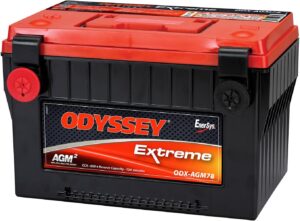
These six AGM models cover specific Group 78 and Group 75 installations. Odyssey’s ODX-AGM78 is the overall pick for its supported Group 78 applications, with 850 CCA and 68 Ah. Optima’s smaller 75/25 models serve their own applications, including a factory-confirmed 2002 Corvette fit. The 2004 C5 uses a different Group 86 application in the manufacturer guide; do not carry an earlier car’s battery recommendation across without checking. Dimensions are length × width × height in inches.
The 6 Best Batteries for a C5 Corvette
| Image | Model | CCA | Size | Price |
|---|---|---|---|---|
| Odyssey ODX-AGM78 (Editor's Choice) | 850 | 10.9 × 6.8 × 7.3 | Check Price |
 | Optima RedTop 34/78 | 800 | 10.06 × 6.94 × 7.88 | Check Price |
 | Optima RedTop 75/25 | 720 | 9.38 × 6.81 × 7.75 | Check Price |
 | Optima YellowTop D75/25 (Best for Added Electrical Loads) | 620 | 9.38 × 6.81 × 7.75 | Check Price |
 | Optima RedTop 78 | 800 | 10.06 × 7.31 × 7.25 | Check Price |
 | Delphi BU9078 MaxStart AGM | 775 | — | Check Price |
Odyssey ODX-AGM78 (Editor’s Choice)
The Odyssey ODX-AGM78 is the strongest all-round choice here for a C5 requiring a Group 78 battery. Its 850 CCA is the highest cold-cranking rating in this comparison, and the 68-Ah capacity gives it a meaningful advantage over the smaller Optimas when electrical demand extends beyond the initial start. The reserve rating is around 135 minutes under the standardized test, not a guaranteed runtime for a particular stereo or other accessory.
Thin-plate pure-lead AGM construction combines starting and cycling capability in a conventional automotive case. Unlike a dual-terminal battery, the ODX-AGM78 uses threaded side connections without an extra pair of top posts. That keeps the connection layout focused on the relevant GM-style installation, with a total height of about 7.3 inches. Odyssey’s current finder lists it for the 2000 Corvette 5.7L.
The trade-off is weight: at about 49.5 lb, it is substantially heavier than the four Optima options here. It is a considered choice for someone who values capacity and cranking output more than shaving a few pounds. Its extra capacity still needs to be kept charged; it does not compensate for a parasitic drain, a poor ground or an unsuitable charging setup.
Pros
- 850 CCA and 68 Ah combine starting output with substantial capacity.
- Pure-lead AGM construction with threaded side terminals.
- Current manufacturer application confirmation for the 2000 C5 5.7L.
Cons
- Heavy at approximately 49.5 lb.
- Group 78 fit does not cover every C5 model year.
Optima RedTop 34/78
The RedTop 34/78 offers a useful middle ground between the Odyssey’s capacity and the smaller RedTop 75/25’s lower weight. It supplies 800 CCA, 50 Ah and a 100-minute reserve rating. For a largely stock C5 with a supported installation, that puts the emphasis on strong starting performance rather than repeated deep accessory discharge.
Its dual-terminal arrangement provides both SAE top posts and GM-style side connections. Optima’s SpiralCell AGM design uses tightly wound lead plates and absorbed electrolyte, so there is no routine water maintenance. At roughly 38.5 lb, it is substantially lighter than the Odyssey while retaining a strong cold-cranking rating.
Optima’s current finder confirms fit for the 2000 Corvette 5.7L. The extra top posts make this case taller than the side-terminal-only RedTop 78, so the two should not be treated as identical batteries. Choose the 34/78 for the supported dual-terminal format and starting output; a dual-purpose YellowTop is a more appropriate direction if repeated cycling is the main concern.
Pros
- 800 CCA, 50 Ah and 100-minute reserve capacity.
- Both SAE top posts and GM-style side terminals.
- Lighter than the Odyssey at roughly 38.5 lb.
Cons
- Taller than the side-terminal-only RedTop 78.
- Starting-focused design is not intended for repeated deep discharge.
Optima RedTop 75/25
The RedTop 75/25 is the lighter, more compact starting-focused option. Its 720 CCA, 44 Ah and 90-minute reserve rating give it a clear role in a suitably specified C5 that does not carry a demanding aftermarket electrical setup. At about 33 lb, it is lighter than the other Optimas in this comparison.
It combines Optima’s SpiralCell AGM construction with dual SAE and GM-style terminals. The shorter case is the important physical difference from the 34/78; it is not simply the same battery with a smaller cranking number. Optima’s current finder confirms the 75/25 for the 2002 Corvette 5.7L.
The compromise is reserve and capacity. Both are below the larger RedTop models and the Odyssey, so this is not the battery to select solely for extended engine-off accessory use. Its strengths are the supported installation, comparatively low weight and ample starting output for an application that meets its rating.
Pros
- 720 CCA in a shorter case.
- Approximately 33 lb, lighter than the other Optimas here.
- Dual terminals and a factory-confirmed 2002 C5 application.
Cons
- Less capacity and reserve than the larger options.
- Not a dual-purpose cycling battery.
Optima YellowTop D75/25 (Best for Added Electrical Loads)
The YellowTop D75/25 is the cycling-oriented alternative to the RedTop 75/25. It pairs 620 CCA with 48 Ah and a 100-minute reserve rating, trading some cold-cranking output for a dual-purpose design. That makes it more relevant to a C5 with a substantial audio system or other electrical equipment used while the engine is off.
The nominal case dimensions match the RedTop 75/25, and both SAE top posts and GM-style side terminals are provided. Optima’s SpiralCell AGM construction holds the electrolyte in the separator, eliminating water additions. The manufacturer’s current finder confirms this model for the 2002 Corvette 5.7L.
The lower 620-CCA rating needs to satisfy the actual car’s requirement, and the battery weighs about 37.5 lb rather than the RedTop 75/25’s 33 lb. It is a purposeful choice for cycling use, not an automatic upgrade for every stock C5. Long storage still calls for a compatible maintainer or an appropriate charging routine.
Pros
- Dual-purpose construction for starting and cycling use.
- 48 Ah and 100-minute reserve capacity.
- Dual terminals in the same nominal case size as RedTop 75/25.
Cons
- Lower cold-cranking output than the RedTop alternatives.
- Heavier than the RedTop 75/25 and still needs charge maintenance.
Optima RedTop 78
The RedTop 78 takes the starting capability of a larger RedTop and puts it in a side-terminal-only format. Its 800 CCA, 50 Ah and 100-minute reserve rating match the key electrical figures of the RedTop 34/78. The distinction is physical: there are no unused top posts, and the total height is around 7.25 inches.
Optima’s SpiralCell AGM construction is the same starting-focused approach used in the other RedTops. Standard GM-style side connections suit the corresponding vehicle layout, and the manufacturer’s current finder confirms the RedTop 78 for a 2000 Corvette 5.7L. It is a particularly clear choice when a supported Group 78 installation is wanted without dual terminals.
At roughly 39.5 lb, it is not the lightest choice, and it does not offer the Odyssey’s 68-Ah capacity. Its advantage is a relatively low case profile with substantial starting output. Like the other RedTops, it is better suited to normal starting and road use than repeated deep discharge from a heavy accessory load.
Pros
- 800 CCA with 50 Ah and a 100-minute reserve.
- GM-style side terminals without additional top posts.
- Lower profile than the RedTop 34/78.
Cons
- Approximately 39.5 lb.
- Less stored capacity than the Odyssey; not a deep-cycling choice.
Delphi BU9078 MaxStart AGM
The Delphi BU9078 combines 775 CCA with a 120-minute reserve rating in a Group 78 case. That gives it a useful place between the starting-focused Optimas and the higher-capacity Odyssey: its cold-cranking figure is slightly lower than the 800-CCA RedTops, while its reserve rating is longer under the same type of standardized test.
Delphi describes reinforced posts, straps and welds, with compression of the internal components and a sealed housing with manifold venting. These are practical construction details for an automotive battery exposed to vibration and repeated temperature changes. AGM construction avoids routine water topping-up, although sound cable connections and a secure hold-down remain important.
The BU9078 belongs in a C5 installation specified for the appropriate Group 78 case and side-terminal layout. Its appeal is the balance of starting current and reserve rather than a dramatic performance claim. It does not establish a universal fit for later C5 applications or a guaranteed service life, and a weak battery should still be tested alongside the vehicle’s charging system.
Pros
- 775 CCA and a 120-minute reserve rating.
- Reinforced internal connections and AGM construction.
- Group 78 automotive format with side terminals.
Cons
- Less cold-cranking output than the 800–850 CCA options.
- Group 78 does not cover every C5 installation.
Frequently Asked Questions About Batteries for the C5 Corvette
What Size Battery Does a C5 Corvette Need?
The Battery Council International group identifies a battery’s case and terminal arrangement. It is a starting point for fit, not a substitute for the car’s replacement specification. C5 applications change across the 1997–2004 model years, so a correct battery for an earlier car is not automatically correct for a later one.
The application table below follows the manufacturer’s year and engine distinctions. Confirm the battery label, terminal layout, hold-down and required cranking rating for the actual vehicle. The reviewed Group 78 and Group 75 batteries are not presented as a universal Group 86 replacement.
C5 Corvette Battery Sizes
| Year | Make | Model | Engine |
Group + CCA |
| 1997 | Chevrolet | Corvette | V8-5.7L | 78, 600 |
| 1998 | Chevrolet | Corvette | V8-5.7L | 78,600 |
| 1999 | Chevrolet | Corvette | V8-5.7L | 78,600 |
| 2000 | Chevrolet | Corvette | V8-5.7L | 78,600 |
| 2001 | Chevrolet | Corvette | V8-5.7L | 75 AGM, 500 |
| 2002 | Chevrolet | Corvette | V8-5.7L | 75 AGM, 525 |
| 2003 | Chevrolet | Corvette | V8-5.7L | 75 AGM, 600 |
| 2004 | Chevrolet | Corvette | V8-5.7L | 86,590 |
What Is the Proper Voltage for a C5 Battery?
The C5 uses a nominal 12-volt system. Resting battery voltage differs from the voltage measured while the charging system is operating, and the correct interpretation depends on the battery chemistry, temperature and state of charge. Optima specifies about 12.6–12.8 volts at full charge for its RedTops and 13.0–13.2 volts for YellowTop. Follow the actual battery and vehicle guidance rather than treating one number as a complete condition test.
A compatible maintainer can help a Corvette that spends long periods parked. The related Toyota Tacoma battery guide covers similar distinctions between starting output, stored capacity and charging habits, but its fitment recommendations apply to that vehicle.
How Long Should a C5 Corvette Battery Last?
Service life depends on temperature, driving pattern, state of charge and the vehicle’s electrical condition. There is no guaranteed five-year lifespan. Repeated short trips, long periods parked and a continuing parasitic load can all leave a battery undercharged.
Slow cranking, repeated discharge or a battery that fails a suitable condition test deserve attention. Check the terminals, cables, grounds and charging system rather than assuming every symptom means the battery alone is faulty. The C6 Corvette battery guide includes a practical drain checklist; its battery sizes should not be transferred to a C5.
Conclusion: The Best Battery for a C5 Corvette
The Odyssey ODX-AGM78 is the overall choice for its supported Group 78 applications, combining 850 CCA with 68 Ah. The RedTop 34/78 and RedTop 78 provide strong starting output with different terminal arrangements and heights. For a supported Group 75 installation, the lighter RedTop 75/25 suits starting-focused use, while the YellowTop D75/25 is the cycling-oriented option for added electrical loads. Delphi’s BU9078 provides another Group 78 balance of cranking power and reserve. Start with the correct application, then compare capacity, weight and the way the car is used.