Are you looking for the best circular saw blades for cutting laminate flooring? Start with a blade designed for the material and sized correctly for the saw you already own.

Laminate’s abrasive surface can wear a general-purpose blade quickly. Tooth material and geometry matter, but diameter alone does not determine cutting quality. These four blades cover different saw formats, so they are not interchangeable alternatives for the same machine.
Compare the four best circular saw blades for cutting laminate flooring below, with the differences in cutting edges, tooth patterns and fit explained.
Top 4 Best Circular Saw Blades for Cutting Laminate Flooring
Diablo D1216LF PCD Laminate Flooring Blade

The Diablo D1216LF is the specialist choice for a large flooring job on a compatible 12-inch saw. Its 16-tooth pattern looks sparse beside the carbide blades in this comparison, but that is deliberate: the cutting edges use polycrystalline diamond, or PCD, with geometry designed for abrasive flooring materials.
Features
Diablo specifies a 12-inch diameter, 1-inch arbor, 0.087-inch kerf and 5,000 RPM maximum. Laser-cut stabilizer vents and the Perma-SHIELD coating address vibration, heat and friction. Its useful distinction is the PCD cutting edge rather than a claim that a higher speed or a larger diameter creates more cutting power.
The limitation is fit. This is not a replacement for the blade in a typical 7¼-inch handheld saw, and the saw must accept its diameter, arbor and speed rating. Consider it for repeated laminate cuts on the right machine; do not reject it simply because another blade has more teeth.
Pros
- PCD cutting edges designed for abrasive flooring
- Purpose-built 16-tooth flooring geometry
- Stabilizer vents and non-stick coating
Cons
- Requires a compatible 12-inch saw and 1-inch arbor
- Specialist flooring design rather than a general-purpose blade
Festool 496309 Laminate 48-Tooth Saw Blade
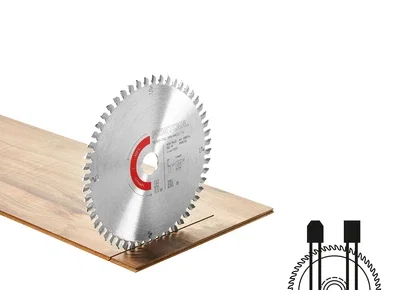
The Festool 496309 brings a laminate-specific cutting pattern to the compatible Festool plunge-saw system. Its 48 carbide-tipped teeth use a trapezoidal-flat, or triple-chip, arrangement, making it a more appropriate choice for laminate and solid-surface work than simply fitting a general wood blade.
Features
The exact dimensions are 160 mm diameter, 2.2 mm cutting width and a 20 mm bore, with a 4° hook angle. Festool also uses laser-cut expansion slots to manage vibration. The thin kerf limits material removal, while the 160 mm diameter suits its intended saw rather than indicating a lack of cutting power.
Its main restriction is the machine specification. This is the 2.2 mm blade for the compatible TS 55, TSC 55 and ATF 55 applications listed by Festool; the saw’s exact version and required blade width still matter. It is not interchangeable with every newer 160 mm thin-kerf system or with a generic handheld circular saw.
Pros
- Triple-chip carbide teeth for laminate and solid-surface material
- 160 mm format for compatible Festool plunge saws
- Laser-cut expansion slots
Cons
- 20 mm bore and 2.2 mm kerf require the correct saw specification
- Not a universal blade for every TS 55 generation
Diablo D1084L 10-Inch 84-Tooth TCG Blade (Editor’s Choice)
The Diablo D1084L remains the overall pick for a compatible 10-inch setup. Its 84-tooth triple-chip design is a useful combination for laminate, melamine and other coated sheet materials, where a tidy finished edge matters more than the fastest possible rough cut.
Features
The blade uses Diablo’s TiCo carbide cutting tips, a thin-kerf design and a Perma-SHIELD coating. Stabilizer vents help control vibration and sideways movement. The ⅝-inch arbor is another important specification: the blade must match the saw, not merely share a nominal 10-inch diameter with it.
The high tooth count and material-specific geometry give it a clear role as a finish-cutting blade. It is not a universal replacement for every miter or table saw, and the carbide tips should not be treated as immune to abrasive wear. Choose it for an appropriate 10-inch laminate-cutting setup; the PCD Diablo is the distinct alternative for a compatible 12-inch flooring saw.
Pros
- 84-tooth triple-chip design for laminate and coated materials
- TiCo carbide tips and non-stick coating
- Thin kerf with laser-cut stabilizer vents
Cons
- Requires a compatible 10-inch saw and ⅝-inch arbor
- Carbide edges still wear in abrasive flooring
Bosch DCB1072 10-Inch 72-Tooth Laminate Blade

The Bosch DCB1072 is a focused 10-inch laminate blade with a 72-tooth triple-chip pattern. It offers another sensible route for a compatible table or miter saw when the job calls for a cleaner finish in abrasive laminated material rather than a general-purpose construction cut.
Features
Bosch specifies a ⅝-inch bore, a 0.098-inch cutting width and a 0.070-inch blade body. Its Brute Carbide formulation is intended to improve resistance to impact damage, while the triple-chip geometry is designed for abrasive materials. The distinction between kerf and body thickness helps explain why the cut is wider than the steel plate itself.
The practical limitation is the same as with any saw blade: correct fit and a supported application come first. Tooth geometry can help produce a clean edge, but it cannot guarantee zero chipping regardless of the material, support or saw condition. This is a circular blade, not a jigsaw blade, and it should be chosen for the machine that will actually use it.
Pros
- 72-tooth triple-chip pattern for laminate
- Manufacturer-specified 10-inch diameter and ⅝-inch bore
- Carbide formulation intended for abrasive-material work
Cons
- Needs a compatible table or miter saw
- Cut quality still depends on material support and machine condition
What to Consider When Buying a Laminate Flooring Blade?
The best saw blade for laminate countertops or flooring must suit both the material and the machine. A clean-looking specification is not a substitute for correct fit.
Material
Laminate-specific carbide blades and PCD flooring blades take different approaches to abrasive wear. Carbide offers familiar fine-cutting tooth patterns; PCD provides a specialist cutting edge for demanding flooring work. Neither material makes a blade suitable for every surface or saw.
Blade Size
Use the diameter, bore and blade width permitted by the saw manufacturer. A larger blade does not automatically cut better, and fitting a smaller blade is not an upgrade unless the machine explicitly allows it. Check the blade’s maximum RPM against the saw’s operating speed.
Teeth
Compare tooth geometry and material, not count alone. A high-tooth-count carbide blade and a low-tooth-count PCD flooring blade are designed differently. There is no universal rule that laminate requires at least 50 teeth.
Kerf
Kerf is the width of the cut, which is different from the thickness of the blade body. A thinner kerf removes less material, but the blade still needs to match the saw, riving knife or splitter where fitted, and the manufacturer’s requirements.
Expansion Slots
Slots and stabilizer vents help manage heat and vibration. Their design matters more than simply having the largest number of openings. They do not compensate for a damaged blade or incorrect mounting.
Durability and Strength
Look for a blade intended for the actual laminate product, then inspect and maintain it as directed. Coatings can help reduce friction and buildup, but they do not make teeth wear-proof or guarantee a particular service life. Tool care matters here just as it does with other precision tools.
Vibration
Blade condition, mounting, machine alignment and workpiece support all influence the finished edge. A laminate-specific design is useful, but no blade can guarantee chip-free results on an unstable setup. Follow the saw and flooring manufacturers’ cutting and dust-control guidance.
So, What’s the Best Circular Saw Blade for Cutting Laminate Flooring?
The Diablo D1084L remains the overall recommendation for a compatible 10-inch saw, with its 84-tooth triple-chip pattern and carbide tips. The D1216LF is the specialist PCD option for a compatible 12-inch flooring setup; Festool’s 496309 serves the specified plunge-saw applications, and Bosch’s DCB1072 is another laminate-focused 10-inch choice.
Choose the circular saw blade that matches the machine and material first. The right diameter, bore, kerf and speed rating are more useful than a blanket promise that one blade fits every saw.