What are the best torque wrenches for gunsmithing? These three compact drivers compare mechanical feedback, digital indication and practical working ranges for precision maintenance.
The useful choice is a tool that covers the required setting, accepts the right bit and provides feedback that is easy to follow. Range, accuracy and display resolution are different specifications, so the highest maximum value is not automatically the best choice.
Top 3 Best Torque Wrenches for Gunsmithing
| Model | Price | |
|---|---|---|
| Weaver Gunsmithing Torque Wrench (Editor's Choice) | Check Details |
 | Wheeler 710909 Digital F.A.T. Wrench | Check Price |
 | Wheeler 553556 Manual F.A.T. Wrench | Check Price |
Weaver Gunsmithing Torque Wrench (Editor’s Choice)
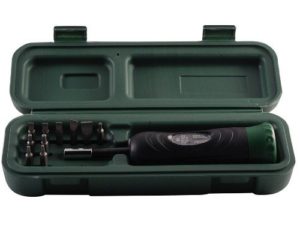
The Weaver 849728 remains the overall pick for its straightforward mechanical design and standard bit fitting. It combines a comfortable screwdriver-style grip with click feedback, so it can be used without batteries or an electronic display. For a compact maintenance kit, that simplicity is a useful advantage.
The original manual specifies 5 in-lb adjustment increments and warns against exceeding 80 in-lb. Its ¼-inch hex holder accepts standard bits, and the supplied selection includes flat, hex and Torx profiles. The storage case keeps the driver and accessories together, making it easier to keep track of the small pieces.
The main compromise is the coarse adjustment scale compared with the digital Wheeler. It also uses screwdriver-style operation rather than a ratcheting drive. Choose the Weaver for mechanical feedback and a familiar bit system; the linked original manual provides the model’s technical details rather than a current stock listing.
Pros
- Mechanical click feedback without batteries
- Standard ¼-inch hex bit fitting
- Supplied bit selection and storage case
Cons
- 5 in-lb adjustment steps are coarser than a digital display
- Original documentation does not establish current availability
Wheeler 710909 Digital F.A.T. Wrench
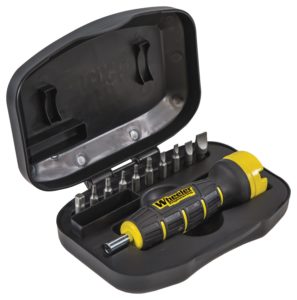
The Wheeler 710909 Digital F.A.T. Wrench is the most informative option while a load is being applied. Its LCD offers LIVE and PEAK modes: one follows the changing reading, while the other retains the highest reading briefly. That is useful when a visible measurement is more helpful than a mechanical click alone.
Wheeler specifies a 15–100 in-lb working range, 0.1 in-lb setting increments and ±2% accuracy across that range. The display resolution and accuracy are separate specifications; a small numerical step does not mean the measurement is exact to that step. Selectable lb-in, kg-cm and N-m units make the display useful for different technical documents.
An audible alert accompanies the visual indication, and the kit includes bits and a protective case. The important trade-off is that this is an indicating driver, not a slipping-clutch or click-stop mechanism that limits effort automatically. It also depends on battery power. Choose it for the display, measurement modes and alerts rather than a promise of automatic protection.
Pros
- LIVE and PEAK display modes
- Specified ±2% accuracy across 15–100 in-lb
- Audible indication and selectable measurement units
Cons
- Requires a working battery
- Indication does not mechanically limit further torque
Wheeler 553556 Manual F.A.T. Wrench
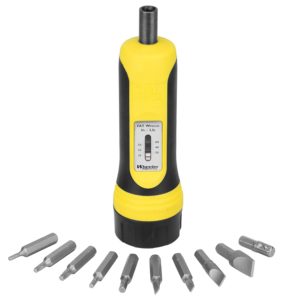
The Wheeler 553556 Manual F.A.T. Wrench is the compact, battery-free alternative. Its broad handle gives a secure grip, while the mechanical adjustment scale keeps the selected setting visible without a screen. The familiar quarter-inch hex format also makes it straightforward to use with suitable driver bits.
The specified adjustment range is 10–65 in-lb. Wheeler states accuracy as ±2 in-lb through 40 in-lb and ±5% above that level, so its accuracy should not be described as a universal 2%. The supplied S2 steel bits and storage case make it a self-contained starting kit for small-fastener work.
The lower maximum range is the main practical limitation compared with the digital model. For work that falls within its calibrated range, the manual F.A.T. offers mechanical feedback and simple storage without batteries to maintain. Bit fit and the equipment maker’s prescribed torque still matter; the driver’s maximum is not a recommended fastener setting.
Pros
- Battery-free mechanical design
- Specified 10–65 in-lb adjustment range
- S2 steel bits and a storage case
Cons
- Lower maximum setting than the digital Wheeler
- Accuracy uses different specifications below and above 40 in-lb
How to Pick the Best Torque Wrench for Gunsmithing
Start with the equipment manufacturer’s specification and choose a tool whose calibrated range includes it. Pay particular attention to units: inch-pounds and foot-pounds are different, with 12 in-lb equal to 1 ft-lb. A larger workshop torque wrench is not automatically suitable for small fasteners.
- Working range: choose for the required settings rather than the largest maximum number.
- Accuracy: distinguish an absolute tolerance, such as ±2 in-lb, from a percentage specification. Display resolution is a separate measurement.
- Bit fit: the correct profile and size matter as much as the holder’s standard fitting. A supplied assortment does not cover every fastener.
- Feedback: a click, an audible alert and a live numerical reading provide different kinds of information. Check whether the tool indicates torque or also has a limiting mechanism.
- Care: follow the model’s storage and calibration guidance. A damaged or suspect tool should be checked rather than assumed accurate.
Tool selection does not replace the relevant maintenance instructions. For other workshop projects, see the guide to PEX crimp tools.
Verdict: What’s the Best Torque Wrench for Gunsmithing
The Weaver remains the overall mechanical recommendation for its standard bit fitting, click feedback and battery-free operation. The digital Wheeler is the stronger comparison when a visible reading and selectable units are priorities, while the manual F.A.T. offers a compact mechanical option within its lower working range.
Choose these torque tools by range, stated accuracy and feedback rather than an unsupported claim that one mechanism is always more accurate. The best fit is the tool that meets the actual maintenance requirement.