The best exhaust for Ninja 300 depends on the look and sound wanted from the bike. A compact shorty gives the rear end a stripped-back appearance, while a larger canister offers a different balance of styling and sound control. The important starting point is a system made for the right Ninja 300 model years.
These six slip-on choices include two Hotbodies canister designs, a carbon-fiber Yoshimura R-77, a matte-black VooDoo and the black and chrome versions of the Radiant Shorty GP. They replace the muffler or muffler-and-link-pipe assembly rather than the complete header system. The original-carbon Hotbodies is the lead pick for its compact profile, carbon-fiber construction and model-specific design.
Best Exhausts for Kawasaki Ninja 300 — Comparison Table
Hotbodies Racing 51303-2400 (Editor’s Choice)
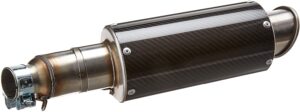
The original-carbon MGP Growler gives the Ninja 300 a compact, purposeful tail-end profile. Its carbon-fiber canister and stainless-steel mid-pipe make an attractive contrast, with much less visual bulk than a long conventional silencer. Hotbodies makes this exhaust in Italy and specifies the current Ninja 300 application as 2013–2017.
The 51303-2400 is the original-carbon canister version, with a different end treatment from the 51303-2404 reviewed below. Its main attraction is that simple, short-canister look. The model-specific connecting pipe and mounting arrangement also make it a more coherent choice than adapting a universal muffler to the bike.
The Growler is designed around an aggressive exhaust note, so it suits a rider who wants the sound to be part of the change. That is also its main compromise: a compact, assertive muffler is a poor starting point when a restrained commuting sound is the priority. Choose it for the carbon finish and styling rather than an assumed horsepower increase.
Pros
- Compact carbon-fiber canister with a stainless-steel mid-pipe.
- Model-specific 2013–2017 Ninja 300 design.
- Made in Italy, with an uncluttered short-canister profile.
Cons
- Aggressive sound may be tiring on longer rides.
- A styling-focused slip-on rather than a complete header replacement.
Radiant Cycles GP527B Shorty GP — Black
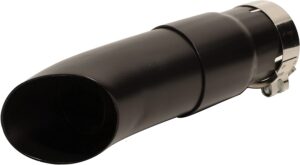
The black Shorty GP takes a simpler approach than a full-size canister. Its short cylindrical body keeps the right side of the Ninja visually light, while the dark finish works well with black wheels and trim. Radiant identifies this 2013–2017 Ninja 300 variant as GP527B.
The appeal is the small silhouette and straightforward slip-on layout. It draws less attention to the muffler itself than a large polished canister, making it a natural fit for a stripped-back build. The black finish is the distinguishing feature here; the chrome GP527C later in the list is another finish of the same Shorty GP family.
This is a sound-forward choice, not a quiet touring muffler. A short body leaves less room for sound attenuation than a larger packed canister, so its appearance should not be the only consideration. It makes most sense when the compact shape and a pronounced exhaust note are both wanted.
Pros
- Very compact cylindrical profile.
- Black finish complements darker trim.
- Dedicated 2013–2017 Ninja 300 version.
Cons
- Shorty layout favors a pronounced exhaust note.
- Less substantial canister styling than the Yoshimura or Hotbodies options.
Yoshimura R-77 147002J220
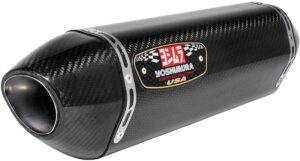
The carbon-fiber R-77 is the choice for a rider who prefers a substantial, sculpted canister to a tiny shorty. Part 147002J220 combines a carbon-fiber sleeve with a carbon-fiber end cap, giving the trapezoidal body a consistent dark finish. Yoshimura specifies this slip-on for the 2013–2017 Kawasaki Ninja 300.
The shaped tailpipe connects the muffler to the original header, and a supporting band holds the canister at the bike’s exhaust mounting point. The installation uses a heatshield at the muffler clamp, so the hardware is more considered than a bare universal sleeve and clamp. The factory parts list also includes the INS-04-K low-volume insert, a useful sound-control feature.
The larger canister has more visual presence than the two Radiant options. That suits the R-77’s superbike-inspired appearance, but it will not give the same minimalist tail-end look. It is a good match for someone who values the carbon construction, distinctive shape and model-specific mounting more than having the shortest possible muffler.
Pros
- Carbon-fiber sleeve and matching carbon end cap.
- Distinctive trapezoidal canister.
- INS-04-K low-volume insert listed in the factory assembly.
Cons
- Bulkier appearance than the shorty alternatives.
- Clamp, spacer and heatshield alignment need care during installation.
Hotbodies Racing 51303-2404
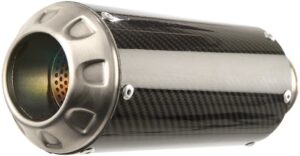
The 51303-2404 gives the MGP Growler a more pronounced metallic end treatment. Hotbodies identifies this variant as the carbon-fiber canister with a stainless-steel end cap, distinct from the original-carbon 51303-2400. The current model-specific application is the 2013–2017 Ninja 300.
The combination is appealing when a completely dark canister looks too plain: the carbon body supplies texture, while the shaped steel cap adds a contrasting focal point at the outlet. It retains the compact Growler proportions and stainless connecting pipe, so the overall effect is still much leaner than a long traditional muffler.
The decision between the two Hotbodies versions is mainly about the canister finish and end-cap design, rather than a proven difference in power. This one suits a bike with other bright-metal details. Like the original-carbon version, its aggressive sound is part of the appeal and a real limitation for a rider seeking a quiet upgrade.
Pros
- Carbon-fiber body with a contrasting stainless-steel end cap.
- Compact MGP Growler proportions.
- Dedicated connecting pipe for the specified Ninja 300 application.
Cons
- Aggressive sound is not ideal for every riding routine.
- The end-cap change does not establish a performance advantage over the 51303-2400.
VooDoo VEEX300L3B Shorty
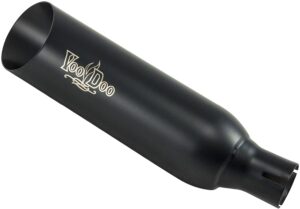
The VooDoo Shorty has a distinctive matte-black, angled-canister look. Its stainless-steel construction and dark finish give it a different character from the carbon Hotbodies and Yoshimura options. VooDoo identifies VEEX300L3B as the black slip-on for the 2013–2018 Ninja 300 EX300.
The kit includes mounting hardware, keeping the visible canister and connection parts within one model-specific package. Its shape is the main reason to choose it: the dark, compact body creates a more angular finish than the simple cylindrical Radiant Shorty GP. Stainless construction is also a practical point of difference from a carbon-sleeved muffler.
This is a performance-style shorty, so sound and fueling deserve attention alongside the appearance. VooDoo notes that an ECU flash or fuel controller may be required; that depends on the complete installation. It is most appealing for a Ninja 300 build where the angular black shape is as important as the change in exhaust note.
Pros
- Matte-black finish with an angular shorty profile.
- Stainless-steel construction.
- Model-specific mounting hardware included.
Cons
- Fueling changes may be needed for the finished setup.
- Shorty styling is a less natural choice when subdued sound is the main goal.
Radiant Cycles GP527C Shorty GP — Chrome
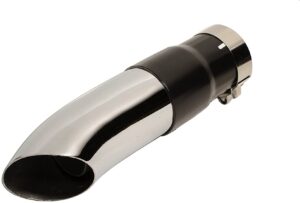
The chrome Shorty GP is the bright-finish counterpart to the black GP527B. Radiant identifies this 2013–2017 Ninja 300 version as GP527C. Its short cylindrical body keeps the same compact proportions, but the reflective finish makes the exhaust a more visible part of the bike’s styling.
That makes it an attractive option when the bike already has polished or silver details. It is also an easy visual comparison with the black version: the choice is about whether the muffler should stand out or blend into the trim. The two finishes belong to the same Shorty GP design family, rather than representing different performance levels.
The main compromise remains the shorty format and its pronounced sound. Chrome also rewards regular cleaning if the bright appearance is part of the appeal. Choose this version for the compact shape and metallic finish, without expecting the color change to produce a different power delivery.
Pros
- Bright chrome finish contrasts with darker bodywork.
- Compact Shorty GP profile.
- Specific 2013–2017 Ninja 300 application.
Cons
- Pronounced shorty sound may not suit longer commutes.
- The reflective finish needs cleaning to keep its appearance.
How to Pick the Best Exhaust for Ninja 300
Slip-On or Full System?
A slip-on replaces the muffler, sometimes together with its connecting pipe, while retaining the original header. A full system also replaces the pipework running from the cylinder head. It does not replace the fuel system. The choices above are slip-ons, so they suit a rider who wants a different rear-end appearance and exhaust note without changing the complete header assembly.
For another sport-bike comparison, see the GSX-R750 exhaust guide; those systems are not interchangeable with Ninja 300 parts.
Compare the Actual Materials
The sleeve, end cap and connecting pipe can use different materials within the same exhaust. A carbon-fiber sleeve gives a different look from stainless steel, but it does not make every other component carbon. Compare the complete assembly and its mounting arrangement rather than assuming that one material guarantees more power, less weight or a longer service life.
Choose a Sound Level for the Way the Bike Is Used
A compact shorty is an assertive styling choice, but a pronounced exhaust note can become tiring on a longer ride. Sound-control inserts are model-specific, and a low-volume insert is not the same thing as a spark arrester. The Yoshimura assembly above lists an INS-04-K low-volume insert. The best exhausts for KLR650 guide also discusses sound-control considerations, although its products fit a different motorcycle.
Fitment, Mounting and Fueling
Check the exact Ninja 300 model years, mounting points and supplied hardware. Follow the chosen manufacturer’s instructions on clamps, gaskets and clearance: for example, Yoshimura’s R-77 instructions do not reuse the stock exhaust gasket. Let the exhaust cool before working, support the muffler during removal and check clearance around the swingarm, rear suspension and brake components.
An oxygen sensor, where fitted, should be handled according to the bike’s service instructions. There is no need to replace one simply because the muffler is being changed. Assess fueling around the whole intake-and-exhaust setup; a slip-on is not a guarantee that a flash is needed, or that it can never be needed.
Wrap-Up: The Best Ninja 300 Exhaust
The original-carbon Hotbodies 51303-2400 remains the lead pick for its compact carbon-fiber profile and dedicated Ninja 300 design. The Yoshimura R-77 is the alternative for a larger carbon canister with a listed low-volume insert, while the Radiant pair offers a straightforward choice between black and chrome shorty styling. VooDoo brings a more angular matte-black shape, and the 51303-2404 adds a stainless end cap to the Hotbodies formula.
Choose an exhaust whose look, sound and installation suit the Kawasaki Ninja 300 and the way it is ridden. The model details above make it easier to compare the finishes, canister styles and sound-control features before deciding.