The best tuners for 7.3 Powerstroke engines combine useful calibration choices with the right fit for the truck. A stock daily driver, a tow vehicle and a modified pickup can need very different settings. These six programmers and chips take different approaches, from a simple handheld flash tuner to a switchable PCM chip and a touchscreen tuner with live gauges.
For the maintenance side of a 7.3 Powerstroke, see Oil for 7.3 Powerstroke Engines; oil selection is separate from tuner selection.
For the turbo-upgrade side of a 7.3L Powerstroke project, see Turbo Upgrade for 7.3L Power Stroke; tuning and turbo selection must suit the complete build.
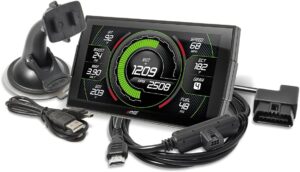
For a 1999–2003 7.3 Powerstroke, the Ford-diesel Edge Evolution CTS3 is the strongest all-in-one option here because it combines flash tuning, monitoring and diagnostics. The other reviews explain where simpler or older devices still make sense. A tune does not increase the truck’s rated towing capacity, fix a mechanical fault or guarantee better fuel economy.
Our 6 Best Programmers for 7.3 Powerstroke
Banks 66410 AutoMind 2

Banks 66410 AutoMind 2 is a straightforward handheld choice for the supported 1999–2003 7.3 Powerstroke applications. Its attraction is the combination of preloaded calibrations and a familiar plug-in programming process, without installing a separate chip on the PCM or keeping a large gauge display mounted in the cab.
Banks develops its own calibrations and includes the ability to scan and clear vehicle trouble codes. That makes the device useful beyond the initial tune: it provides a convenient way to read a fault code and manage the truck’s programming. The emphasis is on a ready-made calibration package rather than building a collection of custom tune files from different suppliers.
AutoMind 2 makes the most sense when the owner wants a ready-made Banks calibration rather than commissioning and managing custom tune files. Its simpler handheld format is convenient to store after programming. Owners who want a larger display permanently available for live readings will find the CTS3 a more complete solution, while exact feature availability still depends on the truck.
Pros
- Preloaded Banks calibrations for supported 7.3 applications.
- Handheld programming without a PCM-mounted chip.
- Trouble-code reading and clearing.
Cons
- Not a large dedicated in-cab gauge platform.
- Features and fitment vary by exact vehicle application.
Edge Evolution 15000

Edge Evolution 15000 is the simpler of the two original Evolution units in this selection. Its manual covers 1994–2003 Ford F-Series 7.3L trucks, and its main appeal is a clear menu-driven approach to choosing a calibration without a modern touchscreen or a long list of custom-tune files.
The device stores the original calibration and offers Tow, Race and Extreme programs, alongside returning the truck to stock. It also reads and clears diagnostic codes. Its data-stream display includes items such as engine speed, engine-oil temperature and transmission-fluid temperature, giving it useful diagnostic depth beyond a basic power-setting switch.
Its age shows in the small display and simpler interface. It should not be confused with the later 15001’s monitoring and adjustment features, and its exhaust-backpressure reading is not an exhaust-gas-temperature measurement. For an owner who already has a compatible 15000, the strong points are simple programming and a useful set of basic data readings; a newer gauge-oriented device is more appealing when starting from scratch.
Pros
- Tow calibration plus higher-performance programs and stock restoration.
- Reads and clears diagnostic trouble codes.
- Displays useful PCM data, including temperature readings.
Cons
- Older display and interface.
- Does not provide an EGT reading simply by plugging into the diagnostic port.
SCT X4 7015

SCT X4 7015 is the most relevant choice here for an owner working with a custom-tuning specialist. The handheld can store up to ten custom tune files, so its appeal is not simply the number of preloaded power levels. It provides a way to load calibrations prepared for the truck’s actual hardware and use.
The backlit display handles supported live vehicle data, and SCT’s LiveLink software supports logging and reviewing PCM information on a computer. The X4 also reads and clears trouble codes and stores the stock file during initial programming. These features make it useful when discussing how a truck behaves with the person supplying its calibration.
The trade-off is that the hardware is only part of the setup: tune availability and adjustable options depend on the vehicle and exact X4 version. The 7015 should not be treated as interchangeable with every newer Ford X4 variant. SCT’s desktop updating and tune-management software requires Windows, and readings such as EGT need the appropriate sensor input rather than appearing automatically on a stock 7.3.
Pros
- Stores up to ten custom tune files.
- Supported live-data monitoring and computer data logging.
- Stock-file storage and diagnostic-code functions.
Cons
- Custom calibrations may be needed for the particular application.
- Desktop software requires Windows; additional sensor readings need suitable hardware.
Edge Evolution 15001

Edge Evolution 15001 adds a more useful monitoring and adjustment interface to the original Evolution concept. Designed for 1999–2003 Ford F-Series 7.3L trucks, it suits owners who want more control over a compatible calibration and a compact display that can remain useful after programming.
Its manual describes viewing up to four parameters at once, setting alerts and recording peak readings. Supported custom options include shift behavior and firmness, along with other application-dependent adjustments. It also supports an installed EGT thermocouple, which is an important distinction from assuming every engine temperature is already available through the diagnostic port.
That makes 15001 more interesting than a basic one-time flash tool, especially for an owner who already has a complete compatible unit. The compromise is its older interface and the installation required for a proper exhaust-temperature probe. Higher-output programs are not interchangeable with the towing calibration; choose the tune for the job rather than treating the strongest setting as the best one.
Pros
- Displays up to four parameters with useful alert and peak-record functions.
- Supports application-specific transmission adjustments.
- EGT monitoring with an installed thermocouple.
Cons
- Older interface than current touchscreen devices.
- EGT monitoring requires the probe installation.
TS Performance 7.3L Six Position Chip

The TS Performance Six Position Chip takes a different route from the handheld flash programmers. It connects at the truck’s PCM and uses a wired rotary switch to select among six programmed positions. Its practical appeal is quick access to different calibrations without going through a handheld reflash for each change.
TS offers the familiar Stock, Hi-Idle and several performance positions, and programs the chip for the truck’s PCM code. The physical switch is simple to use once installed, while the high-idle option can be useful when that function is part of the truck’s operating routine. This is a calibration chip and selector, not a scan tool or a digital gauge display.
Installation is more involved than plugging a handheld into the diagnostic socket: the PCM connection must be prepared correctly and the chip must have the right programming. It is a focused choice for owners who specifically want switchable tunes. Those who also want fault-code functions, live gauges and data logging will need a separate monitoring solution or a different type of tuner.
Pros
- Six switch-selectable programmed positions.
- Calibration prepared for the truck’s PCM code.
- Stock and high-idle positions alongside performance settings.
Cons
- Requires correct PCM-contact preparation and chip programming.
- No integrated scan-tool or gauge display.
Edge Evolution CTS3 85400-100 (Editor’s Choice)
The Ford-diesel Edge Evolution CTS3 85400-100 is the overall choice for a supported 1999–2003 7.3 Powerstroke because it combines tuning and a useful in-cab display. The five-inch color touchscreen gives it a clear advantage over the small handhelds when several readings need to be visible during normal driving or towing.
It provides preloaded calibrations, customizable gauge layouts and diagnostic-code functions in one unit. The Edge Accessory System adds a further practical benefit: suitable extra sensors can feed readings such as exhaust temperature into the same display. That makes it easier to build a monitoring setup around the truck instead of treating the tuner as a device used once and put away.
The extra display and expansion capability are most worthwhile for an owner who actually wants to monitor the truck. EGT monitoring still needs the appropriate probe and accessories, and available vehicle data vary by application. It is also important to choose the Ford-diesel 85400-100 rather than a similar-looking gasoline or GM Evolution. Within that role, it is the most complete combination of programming, gauges and diagnostics in this selection.
Pros
- Five-inch color touchscreen with configurable gauges.
- Combines flash programming, live monitoring and diagnostics.
- EAS expansion for suitable additional sensors.
Cons
- EGT and other additional measurements may require separately installed sensors.
- More display hardware than a simple handheld-only setup needs.
How to Pick the Best Programmer for a 7.3 Powerstroke
Begin with the model year, PCM calibration and transmission, then decide whether the priority is a ready-made tune, custom calibration support or live monitoring. The number of settings matters less than whether the available calibration suits the engine, transmission and work the truck does.
Tune Settings
A towing calibration and a maximum-output program serve different purposes. Follow the device’s instructions for each one, keep the stock calibration available, and do not stack unrelated tuning devices. A modified truck may need a calibration prepared for its actual injectors, turbo and other hardware.
Economy
A tuner cannot guarantee a particular MPG improvement. Load, driving style, gearing, tires and mechanical condition all affect consumption. Judge any change over comparable journeys and use accurate fuel records. More available power can just as easily increase fuel use when it is used frequently.
Transmission
Adjustable shift behavior can be useful on a supported automatic-transmission application, but a firmer shift is not automatically a healthier shift. Match the calibration to the transmission’s condition and the intended load. A tuner cannot repair worn clutches or raise the truck’s rated towing capacity.
Error Diagnostics
Reading a trouble code is a useful starting point for diagnosis. Clearing it does not fix the fault. Handheld and screen-based programmers often include diagnostic functions; a PCM chip with a rotary selector generally does not, so check which type of device fits the rest of the truck’s equipment.
Speed and Rev Limit Adjustment
These options vary by vehicle and calibration. They should not be treated as a reason to exceed the capabilities of the engine, drivetrain or tires. More adjustment menus are not automatically a better match for a working truck.
Monitoring
Separate data already supplied by the PCM from measurements that need extra sensors. A stock 7.3 does not provide a useful exhaust-gas-temperature reading simply because a programmer is plugged in. If EGT monitoring matters, include a suitable probe and installation. Arrange any mounted display so it is readable without obstructing the view of the road.
So, What’s the Best Tuner for a 7.3 Powerstroke?
The Ford-diesel Evolution CTS3 85400-100 is the strongest all-in-one choice here for a supported 1999–2003 truck, combining programming with a clear gauge display and sensor expansion. Banks AutoMind 2 is a simpler handheld option; SCT X4 is relevant when working with custom tune files; and the TS chip suits owners who want a switchable PCM-based setup. The original Edge 15000 and 15001 remain worth understanding for trucks already equipped with them. Choose the supported calibration and monitoring features that fit the truck, rather than chasing a guaranteed horsepower or mileage figure.