Do you need the best jacks for lifted trucks? These five options cover compact bottle jacks, a combined jack and stand, a specialist Hi-Lift and aluminum floor jacks. The right choice depends on where the truck can be lifted, how high that point sits and how much travel the job requires.

A suspension lift, taller tires and added equipment can change the lifting requirements in different ways. Measure the approved lifting point and allow for suspension movement before choosing. A high load rating is useful, but it does not make a short jack reach a tall frame.
Top 5 Best Jacks for Lifted Trucks
| Image | Model | Range (") | Capacity | Price |
|---|---|---|---|---|
 | Torin BIG RED T90403B | 7½– | 4 tons | Check Price |
| Powerbuilt 620471 Unijack (Editor's Choice) | 11– | 3 tons | Check Price |
 | Hi-Lift HL-484 | 4½– | 4,660 lb | Check Price |
 | Arcan ALJ3T | 3.77– | 3 tons | Check Details |
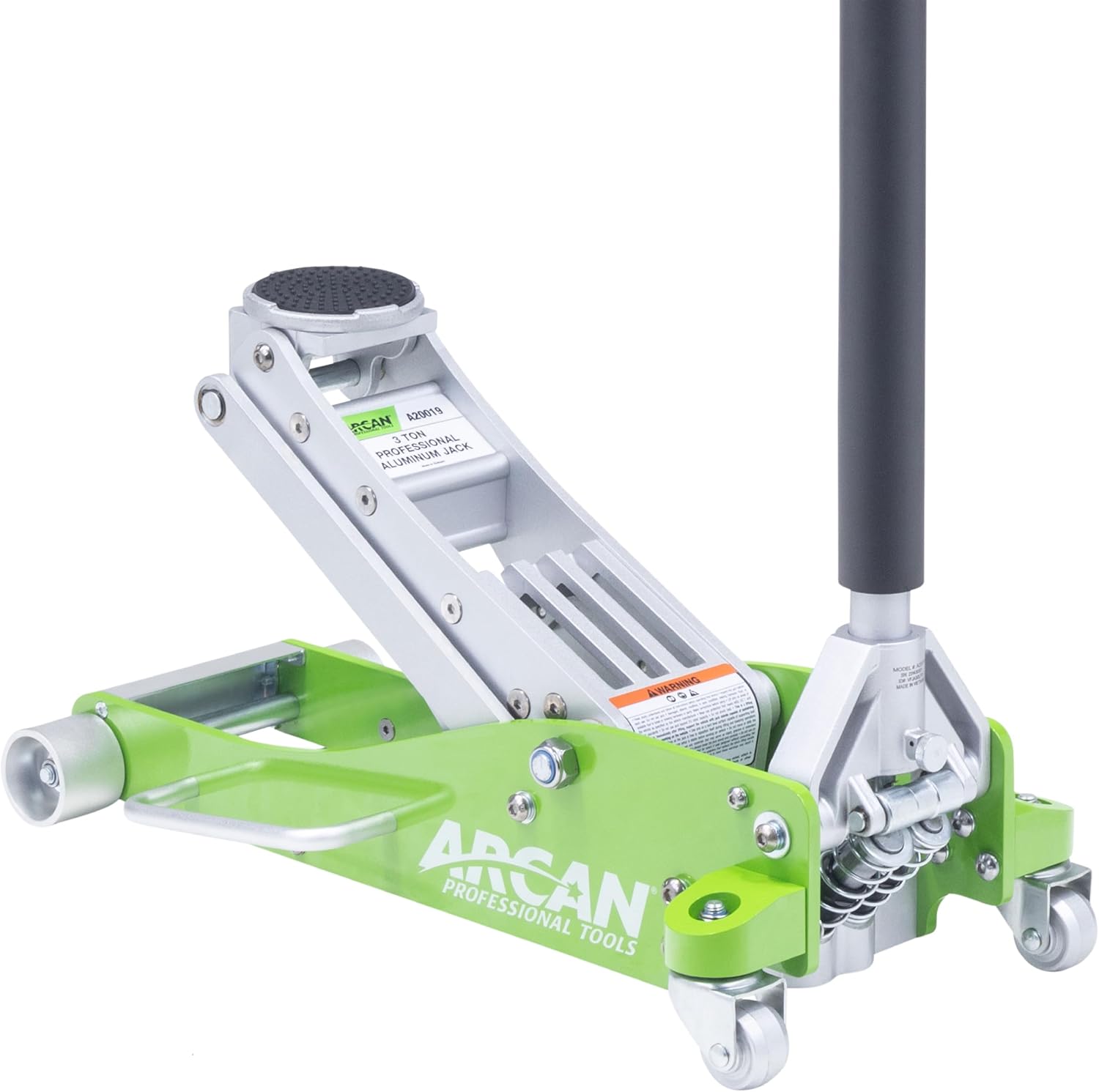 | Arcan A20019 | 3¾– | 3 tons | Check Price |
Torin BIG RED T90403B Hydraulic Bottle Jack
The Torin BIG RED T90403B is the compact bottle-jack option here. Its 4-ton rating offers useful lifting capacity without the wheeled chassis of a floor jack, making it easier to stow with other truck equipment. The trade-off is reach: its 7½–14⁵⁄₁₆-inch saddle range needs to suit the actual lifting point, even on a truck with plenty of ground clearance.
Features
Adjustable screw-top saddle. The screw extension helps bring the serrated saddle closer to the lifting point before hydraulic pumping begins. It is useful for taking up the initial gap, rather than relying on the ram’s travel alone.
Welded steel construction. A welded steel body keeps the design compact and sturdy. The integrated bypass and overload protection help protect the hydraulic system, while the pressure pump provides the lifting action.
A compact lifting tool. Its small footprint is convenient for storage, but this is a lifting device rather than a combined jack stand. Plan the supporting equipment and the working surface as carefully as the jack itself.
Pros
- 4-ton rated capacity
- Compact bottle-jack layout with screw extension
- Serrated saddle and hydraulic-system protection
Cons
- 14⁵⁄₁₆-inch maximum height can limit tall lifting points
- Needs separate suitable support after lifting
Choose the Torin when storage space matters and its height range matches the truck’s approved lifting point. It is particularly easy to pack, but extra capacity alone does not compensate for inadequate lift travel.
Check Price at AmazonPowerbuilt 620471 Unijack (Editor’s Choice)
The Powerbuilt 620471 Unijack remains the overall recommendation for a suitable lifted-truck setup because it combines two jobs in one unit. A hydraulic bottle jack raises the load, while a ratcheting support column locks it at the same lifting point. That is a practical advantage when access makes it awkward to position a separate stand nearby.
Features
Lifts and mechanically supports. The locking bar is the defining feature. As the unit rises, its locking mechanism engages the ratchet column to provide mechanical support. Use the locking procedure in the manual rather than leaving the load resting on hydraulic pressure.
A useful taller starting position. This is the 3-ton, 6,000-pound model with an 11–21-inch advertised range. Its tall starting height suits many higher lifting points, but it may not fit below a low axle or a truck with a deflated tire.
Wide base and dual contact areas. The base spreads the unit’s footprint, and the saddle and platform accommodate different approved applications. It still requires a hard, level surface; a wide base does not make soft ground suitable.
Pros
- Combines hydraulic lifting and mechanical support
- 11–21-inch lifting range
- Avoids moving a separate stand into the same lifting point
Cons
- 11-inch starting height can restrict access
- Correct locking-bar engagement is essential
The Unijack is a strong choice where its saddle fits the approved lifting point and its range covers the job. The manual recommends a matched pair to support one end of a vehicle; it is not designed to support both ends or one complete side simultaneously.
Check Price at AmazonHi-Lift HL-484 Cast and Steel Jack
The Hi-Lift HL-484 is the specialist off-road tool in this group. Its tall mechanical climbing-bar design can reach suitable points that a conventional hydraulic jack cannot, and it can also be configured for winching or clamping as instructed by Hi-Lift. It makes sense for an equipped off-road truck, rather than as a universal substitute for a garage floor jack.
Features
Cast and stamped-steel construction. This model combines cast parts with four high-strength stamped-steel components. The 48-inch designation describes the size class: its specified lifting range is 4½–37.24 inches, with a rated lifting load of 4,660 pounds.
Useful reach, specific contact requirements. Its tall bar is useful only when the truck has suitable lifting points or the correct approved accessories. Ordinary curved or plastic bumpers are not safe contact points for the bare lifting nose.
Mechanical operation and maintenance. The lever mechanism avoids a hydraulic ram, but it needs lubrication and careful handle control. Zinc-plated hardware and a coated finish help protect exposed parts without eliminating maintenance.
Pros
- Substantial vertical reach for a suitable off-road setup
- Mechanical design with manufacturer-supported accessories
- Can serve several recovery-related roles with correct equipment
Cons
- Requires suitable lifting points and practiced handle control
- Not a jack stand or a general-purpose garage floor jack
The HL-484 is worth carrying when its reach and versatility match an off-road vehicle’s equipment. Use its 4,660-pound rated load for lifting decisions; the separate 7,000-pound test figure is not its working capacity.
Check Price at AmazonArcan ALJ3T Aluminum Floor Jack
The Arcan ALJ3T is an aluminum service jack built around a conventional garage-friendly format. Its 3-ton rating and rolling chassis make it useful for approaching a suitable lifting point on a hard floor. The documented version has a 3.77–18.11-inch range, so its value lies in low access and manageable size rather than exceptional high-lift reach.
Features
Aluminum chassis. The manual lists a net weight of 58 pounds. Aluminum helps control weight, but this remains a substantial floor jack to carry. On a smooth garage floor, the wheels do the work of moving it into position.
Useful low access. A saddle that starts below four inches can approach lower lifting points on a truck or another vehicle sharing the garage. Its available travel still needs to cover suspension movement before a wheel leaves the ground.
Straightforward hydraulic operation. The operating handle controls the pump and release valve. Routine fluid checks, lubrication and air purging are part of keeping the mechanism working properly, particularly after transport or storage.
Pros
- 3-ton rated capacity
- Low saddle and wheeled aluminum chassis
- Useful for a garage that serves different vehicle heights
Cons
- 18.11-inch maximum is not a specialist high-lift range
- 58-pound weight still takes effort to carry
The ALJ3T suits workshop lifting where its reach is enough and a hard floor is available. Check the dimensions and instructions for the particular jack before pairing it with a lifted truck.
Check DetailsArcan A20019 Aluminum Low Profile Floor Jack
The Arcan A20019 is a current aluminum floor-jack option with a 3-ton rating, a 3¾-inch starting height and an 18-inch maximum. Its quick-rise mechanism, reinforced lift arm and side carrying handle make it a useful all-round garage tool. It is most attractive when the same jack will serve both a truck and lower vehicles.
Features
Quick-rise lifting. The mechanism brings the saddle up to the load quickly, reducing repetitive pumping during setup. The reinforced lift arm helps control chassis twisting as the jack takes the load.
Aluminum build and carrying handle. Arcan specifies a weight of 56 pounds. The side-mounted handle is useful for positioning and carrying, but the jack remains much better suited to rolling on a garage floor than being carried long distances.
Hydraulic-system protection. Bypass and overload valves help limit overextension and operation beyond the rated capacity. The 18-inch maximum is the more important constraint for many lifted-truck jobs: check that the lifting point and required wheel clearance fall within its reach.
Pros
- 3-ton capacity with quick-rise operation
- Reinforced lift arm and side carrying handle
- Low access for a mixed-vehicle garage
Cons
- 18-inch maximum may be too low for some lifted trucks
- 56-pound weight limits easy portability
Consider the A20019 when low access and garage versatility matter more than maximum height. For a high lifting point, compare its actual reach with the taller Unijack or a suitable specialist setup before choosing.
Check Price at AmazonHow to Pick the Best Jack for a Lifted Truck
Choose the lifting method around the vehicle’s approved points, required load and working surface. There is no single height range or capacity that automatically suits every lifted truck.
Type of Jack
- Hydraulic floor jack: A wheeled chassis is convenient on a hard, level garage floor. Low access can be useful, but the maximum height and suspension travel may limit use on a lifted truck. Compare low profile jacks when the same tool also needs to serve lower vehicles.
- Bottle jack: Compact and easy to store, with a relatively tall starting height. Match the saddle range to the actual lifting point. An ordinary bottle jack needs separate suitable support after lifting.
- Combined jack and stand: A unit such as the Unijack adds a mechanical locking column at the same point where it lifts. Follow the model’s locking and support instructions.
- Hi-Lift-style mechanical jack: Useful for equipped off-road vehicles with appropriate lifting points or approved accessories. It is a specialist tool with particular handling requirements, not a substitute for every floor-jack task.
Weight Capacity
Use the rated working capacity, not a test load or breaking-load figure. The load at a jacking point depends on the vehicle and lifting procedure. Follow the truck manufacturer’s instructions rather than assuming that a lift kit establishes the required jack capacity.
Lifting Range
Check the height of the approved point both in normal use and in the situation you are preparing for, such as a flat tire. The jack must fit beneath it and have enough travel left to lift as required. A suspension lift can change frame height more than axle height, while larger tires affect both.
Sturdiness
Use the jack on the surface specified by its manufacturer, with the load centered on the saddle. Wheels, base width and contact pads matter, but none make an unsuitable surface safe. Bent parts, cracked welds or hydraulic leaks are reasons to remove equipment from service.
Heavy-Duty Build
Steel, cast components and aluminum can all be appropriate when the complete jack is designed and rated for the task. Compare the actual load rating, weight and maintenance instructions instead of judging suitability from material alone.
Safety Features
Bypass valves and overload protection are useful hydraulic safeguards. Mechanical locks perform a different role by supporting the raised load when engaged as instructed. Ordinary bottle and floor jacks are lifting devices; use suitable jack stands before working beneath the vehicle. A Hi-Lift also requires proper support of the raised load.
Chock wheels as instructed, keep people clear while raising or lowering, and never add improvised spacers or extensions to gain height. Read the instructions for both the truck and the exact jack before use.
Conclusion: What’s the Best Jack for Lifted Trucks?
The Powerbuilt 620471 Unijack is the overall recommendation where its 11–21-inch range and saddle suit the truck. Combining lifting and mechanical support at the same point is a useful practical advantage.
The Torin is easier to stow, the Hi-Lift offers specialist reach for equipped off-road vehicles, and the Arcan floor jacks suit garage work where their maximum height is sufficient. Choose around the truck’s lifting points and the job rather than expecting one design to cover every lifted vehicle.