The best coilovers for Acura RSX Type-S balance the stance you want with the roads you actually drive. Adjustable height and damping can make the car feel more composed, but spring rates, available travel and a careful alignment matter just as much as the number of adjustment clicks.

These five kits cover specific 2002–2006 RSX DC5 applications. Godspeed MSS0131-B remains the overall starting point for its straightforward 16-step adjustment and independent height setting; the other options add different spring rates, finer damping adjustment or distinctive mounting details. All need a proper setup rather than simply being wound to their lowest position.
Best Coilovers for Acura RSX Type-S — Comparison Table
| Image | Model | Price |
|---|---|---|
| Godspeed MSS0131-B (Editor's Choice) | Check Price |
 | Godspeed MMX2270-A | Check Price |
 | Ksport CAC030-KP | Check Price |
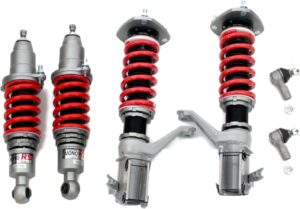 | Godspeed MRS1510-B | Check Price |
 | Rev9 R9-HS2-013_1 | Check Price |
Godspeed MSS0131-B (Editor’s Choice)
The MonoSS is the approachable starting point in this group. Its 16 rebound settings give a useful range of adjustment without encouraging endless knob-turning, while separate height and spring-preload adjustments let a competent installer establish the stance without using spring compression as the height control.
This RSX kit pairs a 52 mm monotube damper layout with 10 kg/mm front and 12 kg/mm rear springs. The front pillowball mounts incorporate camber plates; the rear uses standard top mounts. Those front plates are useful when dialing in alignment after lowering, although they do not replace a complete alignment or correct every suspension-geometry issue.
It remains the overall choice here for its clear, manageable feature set. The trade-off is a performance-oriented spring and mount package: it should not be bought on the assumption that it will ride more softly than a healthy factory suspension. A sensible height, adequate travel and restrained damping settings matter more than choosing the stiffest click.
Pros
- 16 rebound settings with independent height and preload adjustment.
- Front pillowball mounts with camber plates.
- Application-specific 10 kg/mm front and 12 kg/mm rear springs.
Cons
- Performance springs and pillowball mounts can reduce isolation.
- Fewer damping steps than the other kits here.
Godspeed MMX2270-A
The MAXX is the more assertive Godspeed option. It combines 40 damping settings with 12 kg/mm front and 14 kg/mm rear springs, giving it a firmer starting specification than the MonoSS and MonoRS kits in this comparison. That makes it more interesting for a driver prioritizing a responsive lowered setup than someone mainly chasing extra softness.
Godspeed specifies front pillowball camber plates and standard rear top mounts for the RSX application. The adjustable-height layout provides room to establish the stance and alignment, while the wider damping range allows smaller setup changes. More clicks offer finer adjustment; they do not by themselves prove better grip or damping quality.
The main attraction is the combination of adjustment range and firmer springs for an enthusiast willing to tune the car. On broken roads, that same spring specification can be a compromise. Keep enough usable travel and resist treating maximum stiffness as the default road setting.
Pros
- 40 damping settings.
- 12 kg/mm front and 14 kg/mm rear springs.
- Front camber plates and adjustable height.
Cons
- Firmer spring specification may be less forgiving on rough roads.
- Extra adjustment requires patient setup rather than guaranteeing a better result.
Ksport CAC030-KP
The Kontrol Pro stands out for its 36-step control that changes compression and rebound together. One knob per damper makes adjustments relatively straightforward, while its 8.7 kg/mm front and 9.5 kg/mm rear springs give this RSX kit a different baseline from the stiffer Godspeed combinations above.
The application-specific package uses a high-pressure monotube layout and front pillowball camber-adjustable upper mounts. Machined 6061-T6 aluminum mounts, collars and perches are paired with zinc-plated steel shock bodies. Ksport also makes the dampers rebuildable, a useful ownership feature for a setup intended to stay on the car.
This is an appealing alternative for someone who values serviceability and a single coordinated damping adjustment. That simplicity has a limit: compression and rebound cannot be tuned independently with the one-knob control. Professional installation, clearance checks and alignment remain part of getting the system to work well.
Pros
- 36-step combined compression and rebound adjustment.
- Rebuildable dampers with application-specific spring rates.
- Front camber adjustment and corrosion-protected construction.
Cons
- Compression and rebound are not independently adjustable.
- Pillowball mounts can transmit more road noise than compliant factory mounts.
Godspeed MRS1510-B
The MonoRS offers finer rebound adjustment than the MonoSS without moving to the MAXX kit’s higher spring rates. Its 32 settings work with 10 kg/mm front and 12 kg/mm rear springs, making it a logical comparison for owners who want more tuning steps around a similar spring specification.
The distinguishing hardware is the 1.75-inch extended rear top mount, and Godspeed identifies tie-rod ends as included with this RSX application. The kit also uses 52 mm monotube dampers, front pillowball camber plates and separate ride-height and preload adjustments. These are meaningful setup details, not a promise that every lowered car will retain factory geometry.
Its extra adjustment and application-specific hardware make it attractive for a carefully planned lowered build. The manufacturer describes it as a lowering setup rather than a way to restore factory ride height. The tie-rod installation and final alignment deserve attention, so this is a job for someone familiar with the RSX suspension.
Pros
- 32 rebound settings with independent height adjustment.
- 1.75-inch extended rear top mount.
- Tie-rod ends included for the specified application.
Cons
- Designed for lowering rather than factory-height restoration.
- Additional steering hardware needs correct installation and alignment.
Rev9 R9-HS2-013_1
The Hyper-Street II combines 32 rebound settings with 8 kg/mm front and 10 kg/mm rear springs. Those rates are lower than the Godspeed specifications above, giving it a different starting point for a lowered street car. Spring rates alone still cannot predict comfort: damping, tires, travel and the final height all contribute.
The monotube dampers use steel-alloy bodies with aluminum hardware. Independent spring-tension and ride-height adjustments let the lower bracket set the stance instead of relying on extra spring compression. The rebound control then provides scope to tune how the suspension settles after a road input.
Rev9 explicitly identifies this as a lowering kit that does not adjust back to factory ride height. Installation instructions are not supplied with the exact kit, so experienced professional installation is especially sensible. It is worth considering when that lowered-use brief matches the build and the owner is prepared to budget for a proper setup.
Pros
- 32 rebound settings.
- Independent ride-height and spring-tension adjustment.
- 8 kg/mm front and 10 kg/mm rear spring specification.
Cons
- Does not adjust to factory ride height.
- No installation instructions supplied with the exact kit.
Frequently Asked Questions About Coilovers for Acura RSX Type-S
How Does the RSX Type-S Suspension Differ from the Base Model?
A coilover combines a spring and damper in one assembly. The RSX uses a Control-Link MacPherson-strut front suspension and a compact double-wishbone rear suspension. Acura’s Type-S specification includes firmer rear springs and more compression and rebound damping than the base car. A coilover conversion replaces important parts of that original tuning, so the aim should be a balanced setup rather than lowering alone.
Will Type-S Coilovers Fit a Base RSX?
Some complete kits cover both trims, but that must be stated for the exact part number. Godspeed lists the specified RSX DC5 kits for the relevant 2002–2006 applications; Ksport’s CAC030-KP page specifically identifies Type-S. Do not assume that every factory spring, damper, mount or anti-roll bar interchanges simply because some complete aftermarket kits cover both models.
Will Civic Coilovers Fit an RSX?
Use an explicit manufacturer application for the complete kit. The Civic name covers different chassis and suspension layouts, and superficially similar front struts can differ at the steering-arm and tie-rod connection. A kit marketed for an RSX should not be treated as a universal Civic conversion, nor should changing tie-rod ends alone be assumed to solve every fitment issue.
Do More Damping Clicks Mean Better Coilovers?
Not automatically. More steps can help fine-tune a suitable damper, but spring rates, valving, mounting design and available travel matter more than the click count on its own. Start with the manufacturer’s recommended baseline and make small, consistent changes. A full-stiff setting is not automatically the best choice for road grip or comfort.
How Low Should an RSX Be Set?
Stay within the kit’s specified adjustment range and retain adequate bump and droop travel. Check tire clearance, steering movement, brake-hose routing and suspension alignment at the chosen height. Independent height adjustment avoids using preload as the main lowering control, but it does not eliminate the geometry and clearance consequences of lowering the car.
Which Coilovers Are the Best Starting Point?
Godspeed MSS0131-B remains the overall starting point for its straightforward 16-step adjustment and useful front camber plates. Compare MonoRS for finer rebound tuning and its extended rear mount, MAXX for the firmer spring specification, Ksport for its rebuildable combined-adjustment design, and Rev9 for its different spring-rate combination. Choose around the car’s use and road conditions, then have the setup aligned and checked properly.
For workshop equipment, see the guide to low-profile jacks. Use suitable axle stands and the vehicle’s specified lifting points whenever work requires supporting the car.