Choosing the best carb for 302 starts with the engine’s actual setup. A mild Ford 302 street engine, a high-revving build and a car retaining its original two-barrel intake need different carburetors. The right choice should suit the manifold, airflow demand and transmission linkage—not just the engine displacement.
For a Dodge 318 rather than a Ford 302, use the engine-specific guide to Carb for Dodge 318.

These six carburetors include 500- and 600-CFM Edelbrock four-barrels alongside 2100-style two-barrel replacements. The 1403 is the lead choice for a mild street build with the appropriate square-bore intake; the two-barrels serve owners keeping a compatible original-style setup. Compare the differences below before changing the fuel system.
Best Carbs for 302 — Comparison Table
Edelbrock 1403 Performer Carburetor (Editor’s Choice)
The 1403 makes a sensible starting point for a mild 302 street build with a matching four-barrel intake. Its 500-CFM rating keeps the emphasis on the airflow needs of a smaller engine, while an electric choke handles cold-start enrichment without a manual choke cable.
The aluminum Performer uses metering rods to manage the transition between fuel circuits. Rod changes can be made without removing the carburetor or draining its fuel, which makes calibration more approachable than a design that needs deeper disassembly for every adjustment. The two-piece body and square-flange layout are familiar, straightforward features for a conventional street induction system.
The appeal is a manageable four-barrel combination rather than the largest possible airflow number. Its limits are just as clear: a two-barrel manifold needs replacement with a compatible four-barrel intake, the choke needs correct wiring, and the throttle and transmission linkage must match the car. A more demanding high-RPM combination may call for a different capacity and calibration.
Pros
- 500-CFM four-barrel configuration for a suitably matched small-engine build.
- Electric choke avoids a manual choke cable.
- Accessible metering-rod changes simplify calibration.
Cons
- Requires a compatible square-bore four-barrel intake arrangement.
- Not the automatic choice for a heavily modified high-RPM engine.
Edelbrock 1406 Performer Carburetor

The 1406 moves the Performer formula up to 600 CFM while retaining an electric choke. It is worth comparing with the 1403 when the 302’s camshaft, intake and operating range justify additional airflow. More capacity alone does not guarantee better acceleration or fuel economy.
Edelbrock gives this model an economy-oriented calibration and the same useful metering-rod approach to tuning. Its aluminum body, single fuel inlet and square-bore four-barrel format make it a conventional street option. The electric choke is convenient once its power supply and adjustment are correct.
The main consideration is the overall engine combination. Edelbrock does not recommend the 1406 for RPM or Torker II intake manifolds, so it should not be paired with an intake simply because the bolt pattern appears suitable. For a compatible street build, it offers a clear step in capacity without making carburetor size the whole decision.
Pros
- 600-CFM capacity with an electric choke.
- Metering-rod calibration system.
- Factory calibration emphasizes street fuel economy.
Cons
- Manufacturer does not recommend it with RPM or Torker II manifolds.
- Extra airflow is useful only when the engine combination needs it.
Auto Parts Prodigy 2100/2150 Carburetor

This Auto Parts Prodigy unit takes the original-style two-barrel route rather than converting the engine to a four-barrel intake. It combines a 2100/2150-style layout with an electric choke and is intended for the specified Ford 289, 302 and 351 applications.
The manufacturer specifies 1.14-inch venturis and .049 jets, giving a more concrete starting point than a generic “fits a 302” description. A mounting gasket is included, and the metal construction retains the familiar compact form of this carburetor family. An inlet fuel filter is required to keep debris out of the metering passages.
The advantage is retaining the basic two-barrel arrangement on a suitable engine. It is not a promise of extra horsepower or an exact reproduction of every Motorcraft revision. Match the base, fuel connection, vacuum fittings and linkage to the removed unit, then establish the float, choke and idle settings for the car.
Pros
- 2100/2150-style two-barrel layout.
- Electric choke and included mounting gasket.
- Specified venturi and jet sizes provide a tuning reference.
Cons
- Requires an inlet fuel filter and correct initial setup.
- Engine displacement alone does not establish an exact replacement.
Dromedary 2100 Carburetor

The Dromedary 2100 is another replacement for a compatible two-barrel installation. Its compact 2100/A800 format is the attraction for a Ford 302 owner who wants to retain that style of intake rather than add a four-barrel conversion.
The manufacturer identifies it for the specified Ford 289, 302 and 351 applications. The two-barrel layout keeps both intake passages in the familiar original-style arrangement, and the external connections remain important to the installation. Compare the photographed fuel inlet, vacuum ports and throttle lever with the existing carburetor before choosing it.
This is a practical replacement category, not a documented performance upgrade. A worn carburetor can cause drivability trouble, but replacing it will not cure ignition faults, vacuum leaks or incorrect fuel pressure. Allow for setup and adjustment instead of expecting every engine to run correctly on the supplied calibration.
Pros
- 2100/A800-style two-barrel configuration.
- Compact alternative to a four-barrel conversion.
- Intended for the specified Ford small-block applications.
Cons
- Ports and linkage must match the existing installation.
- Initial calibration may need adjustment for the engine.
MOSTPLUS 2100-A800 Carburetor

The MOSTPLUS 2100-A800 is aimed at retaining a compatible two-barrel setup on an older Ford. The manufacturer includes specified 302 applications in its fitment information, including the relevant 1968–1973 Mustang configurations. That makes it a replacement option for a particular original-style arrangement, not every Mustang or every 302 ever built.
The aluminum-alloy unit has an automatic choke and comes with the mounting gasket and seal. MOSTPLUS specifies 1.16-inch venturis for this version, giving it a useful distinction from the 1.14-inch Auto Parts Prodigy unit above. The two specifications should not be treated as proof of a guaranteed performance difference on the same engine.
The appeal is a complete carburetor in the familiar A800 replacement format. Clean fuel passages and filters matter, and the gasket must not obstruct the relevant passages. Installation instructions are not included, so an experienced installer is useful if the existing linkage or vacuum routing is unfamiliar.
Pros
- 2100-A800 two-barrel format with an automatic choke.
- Aluminum-alloy construction.
- Mounting gasket and seal included.
Cons
- Manufacturer supplies no installation instructions.
- Requires a matching original-style application and correct passage alignment.
Edelbrock 1901 AVS2 Carburetor
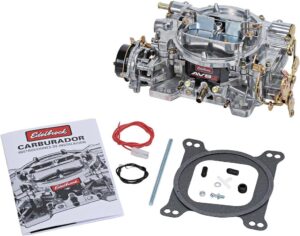
The 1901 AVS2 combines a 500-CFM rating with annular boosters and an electric choke. For a small-displacement street engine, the attraction is not simply peak airflow: the annular booster design is intended to distribute fuel finely as air passes through the primary venturis.
It uses a square-flange four-barrel layout and is calibrated for single-carburetor applications. Timed and full-manifold vacuum ports give the installer the connections needed to match the ignition-advance arrangement. Its satin aluminum finish also suits a conventional engine bay without the visual emphasis of a chrome carburetor.
The 1901 is the more interesting comparison for an owner weighing the 1403’s familiar Performer design against the AVS2 booster arrangement. It still needs the correct intake, linkage and calibration, and the annular boosters do not make it self-tuning. Treat it as a configurable street carburetor rather than an automatic cure for every hesitation or starting problem.
Pros
- 500-CFM AVS2 with annular boosters.
- Electric choke and single-carburetor calibration.
- Timed and full-manifold vacuum connections.
Cons
- Requires a compatible square-flange four-barrel installation.
- Still needs engine-specific setup and tuning.
How to Pick the Best Carburetor for a Ford 302 Engine
Start With the Existing Intake and Engine Combination
A Ford 302 is not a single induction specification. Identify the engine, intake, camshaft and intended RPM range. The two-barrel replacements above serve a different installation from the square-bore Edelbrock four-barrels. An original Boss 302 or a substantially modified engine also deserves its own airflow and calibration assessment.
Choose Airflow for the Engine, Not the Biggest Number
Airflow demand depends on displacement, RPM and how effectively the engine fills its cylinders. A mild street 302 can make a 500-CFM carburetor a sensible starting point; a different build may justify 600 CFM or another capacity. Two- and four-barrel CFM figures are commonly measured at different pressure drops, so they are not directly comparable. The Chevy 305 carburetor guide discusses another small V8, but its applications should not be assumed to fit a Ford.
Check Linkage, Choke and Clearance
Confirm the manifold flange, air-cleaner height, fuel-line connection and vacuum ports. Electric chokes need the specified electrical supply; manual chokes need an appropriate cable. These Edelbrock carburetors are not intended for computer-controlled applications, and their installation instructions prohibit a four-barrel-to-two-barrel adapter. Automatic transmissions can require dedicated linkage hardware. Edelbrock’s 1483 Ford kickdown adapter is not for AOD transmissions: an AOD needs the correct throttle-valve linkage geometry and adjustment, not a generic kickdown connection.
Make Tuning and Maintenance Part of the Choice
Accessible jets, metering rods and service parts are useful when the engine’s requirements change. Set fuel pressure, float level, choke operation and idle mixture according to the exact carburetor instructions. A clean fuel filter helps protect small passages, while vacuum leaks and ignition timing must be addressed before judging the carburetor’s calibration.
When Should You Replace a Carburetor on a 302?
Hard starting, hesitation, a rich exhaust or poor idle can justify diagnosis, but none proves the carburetor must be replaced. Check ignition, fuel pressure, vacuum leaks and choke operation first. Worn throttle shafts, damaged castings or persistent internal problems may make replacement more sensible than further adjustment. Any fuel leak needs prompt attention before the engine is run again.
Final Thoughts: Best Carburetor for a 302 Engine
The Edelbrock 1403 remains the lead choice here for a mild street 302 with the appropriate square-bore intake. Compare the 1406 when a compatible combination needs 600 CFM, or the 1901 AVS2 for its annular-booster design. For an engine retaining a suitable two-barrel intake, the three 2100-style replacements are a different, more direct category. Choose the carburetor around the complete engine and installation rather than displacement alone.