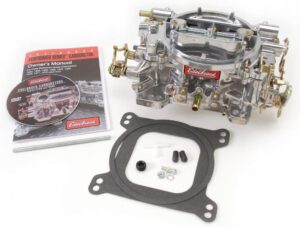
The best carb for a Chevy 305 fits the intake and the airflow the engine needs. The Edelbrock 1405 is the pick for a compatible 600 CFM street setup with a manual choke. Compare the 500 CFM Edelbrock 1403 for a milder combination.
Top 5 Best Carburetors for a Chevy 305
Edelbrock 1405 (Editor’s Choice)
The Edelbrock 1405 is a useful starting point for a street-oriented 305 with a compatible four-barrel intake. Its 600 CFM Performer design combines a manual choke with an air-valve-controlled secondary system, so it is more than a choice based on the airflow number. The appeal is accessible calibration and familiar, serviceable hardware.
Metering rods handle the transition between operating circuits, and rods and step-up springs can be changed without removing the carburetor. That makes adjustments less involved than dismantling the whole assembly. The aluminum two-piece body, tub-style fuel bowls and rear-pivot floats complete a conventional, serviceable design.
The manual choke is the main everyday compromise: it needs a cable and driver input during warm-up. The 1405 is most attractive for someone comfortable with that control and willing to match calibration to the engine. For a modest 305 where automatic choke operation and a smaller airflow rating are preferable, the 1403 is a strong alternative.
Pros
- Accessible metering-rod and step-up-spring tuning.
- 600 CFM Performer design with air-valve secondaries.
- Aluminum body and conventional service parts.
Cons
- Manual choke requires a cable and driver operation.
- Needs suitable intake fit and engine-specific calibration.
Demon 1900 Street Demon
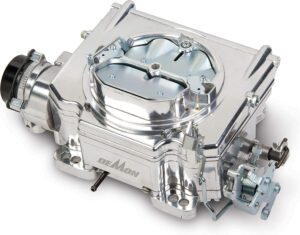
The Demon 1900 approaches street driving through relatively small primary bores and a larger secondary section. Its 625 CFM rating comes from the complete system, while the primary bores handle much of ordinary driving. The Goggle Valve Secondary design is the distinctive feature, rather than simply offering four identical openings.
A torsion-spring-controlled secondary air valve helps manage the transition as demand increases. Two-stage metering rods provide a tuning route, and a single fuel inlet simplifies the line arrangement compared with dual-feed designs. The electric choke also removes the need to operate a dashboard choke cable.
The 1900 is appealing for a compatible street build that values this progressive layout and automatic choke operation. It still needs the right intake clearance, linkage and calibration. The main attraction is having those street features alongside an adjustable secondary air valve, so the transition can be matched to the engine rather than left to a fixed mechanical opening alone.
Pros
- Small primary bores with an air-valve-controlled secondary section.
- Electric choke and single fuel inlet.
- Accessible two-stage metering rods.
Cons
- Intake, linkage and air-cleaner clearance still need planning.
- Calibration must suit the actual engine.
Holley 0-80457S

The Holley 0-80457S brings a familiar 600 CFM vacuum-secondary layout to the shortlist. It is aimed at stock to mildly modified V8 street applications, making it a more measured starting point than a large mechanical-secondary carburetor for a modest 305. An electric choke adds convenience during warm-up.
The rear barrels respond to engine demand through the vacuum-secondary mechanism. That gives the installation a degree of flexibility across different vehicle weights and gearing, provided the calibration is appropriate. A single-feed fuel inlet keeps the fuel-line layout straightforward, and the polished aluminum body gives it a clean appearance.
The limitation is that a broadly calibrated street carb still needs proper setup. It requires a compatible square-bore intake arrangement, correct choke wiring and suitable throttle and transmission linkage. For an owner who prefers the Holley format and automatic choke operation, it offers a sensible feature mix without making fuel-economy or power gains a certainty.
Pros
- 600 CFM rating with vacuum secondaries.
- Electric choke for automatic warm-up control.
- Single-feed fuel layout and aluminum body.
Cons
- Square-bore fit and linkage need to suit the vehicle.
- Fuel pressure and calibration require proper setup.
Edelbrock 1403
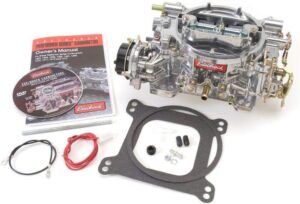
The Edelbrock 1403 is particularly relevant to a modest-displacement street engine. Its 500 CFM rating is smaller than the other options here, and Edelbrock specifically positions this version for small-cubic-inch applications. That makes it worth considering when the goal is a responsive, usable 305 rather than an unnecessarily large carburetor.
It combines an electric choke with the Performer family’s metering-rod system and air-valve secondaries. Rods and step-up springs provide accessible calibration changes, while the electric choke avoids a dashboard cable. The square-flange aluminum construction keeps it within a familiar aftermarket installation format.
The smaller rating is a deliberate choice, not a limitation to ignore in every build. A highly modified engine running at higher speeds may need a different specification, while a near-standard street combination may benefit more from appropriate sizing and tuning. Check intake, linkage and choke wiring before choosing it; the 1403 is not an automatic conversion for a factory feedback-carburetor or EFI system.
Pros
- 500 CFM version intended for small-cubic-inch applications.
- Electric choke and air-valve secondaries.
- Accessible Performer metering-rod calibration.
Cons
- Less suited to a build that genuinely needs greater airflow.
- Requires compatible intake, linkage and choke wiring.
Holley 0-76650BL Ultra Double Pumper

The Holley 0-76650BL is the performance-focused option, with a 650 CFM rating and mechanical secondaries. Its blue anodized billet metering blocks and base plate are distinctive, but the more important point is the Double Pumper layout: two accelerator pumps provide enrichment as the throttle is opened.
An electric choke gives this version automatic warm-up control, while four-corner idle adjustment provides more control over the idle mixture. Fuel-bowl sight windows help with float-level checks. These are useful tuning features for a prepared street/strip combination, rather than reasons to expect effortless results on an otherwise standard 305.
The trade-off is the need to match the carburetor to the drivetrain and engine response. Mechanical secondaries demand more attention to the combination than choosing a street carb solely for everyday convenience. For a suitably modified 305 with the right transmission, gearing and tune, it offers useful control; a mild cruiser is better served by one of the more conservative choices above.
Pros
- 650 CFM mechanical-secondary Double Pumper design.
- Electric choke and four-corner idle adjustment.
- Billet metering blocks/base plate and fuel-bowl sight windows.
Cons
- Needs a suitably matched performance engine and drivetrain.
- More involved choice for a mild everyday cruiser.
How to Pick the Best Carburetor for the 305 Chevy Engine
If your Chevy 305 project also involves a camshaft change, see our guide to cam selection for a Chevy 305 as a separate part of the engine build.
The Edelbrock 1405 remains the overall pick for a compatible street-oriented build with manual choke control. The smaller 500 CFM Edelbrock 1403 is particularly worth considering for a modest engine, while the Demon and Holley options offer different secondary controls and tuning features. The 650 CFM Ultra Double Pumper is the specialised performance choice rather than the default for a stock 305.
CFM: Match the Engine, Not the Biggest Number
A useful starting estimate is displacement in cubic inches multiplied by maximum engine speed, divided by 3456, then multiplied by volumetric efficiency expressed as a decimal. A 305 at 6000 rpm calculates to about 530 CFM at 100% volumetric efficiency, or roughly 450 CFM at 85%. This is a sizing guide, not a guarantee that a particular carb will deliver a power or economy result.
Heads, camshaft, intake, exhaust and intended operating range change the decision. A stock or mild street 305 does not automatically need a large street/strip carburetor. Compare airflow alongside the secondary mechanism and available calibration, rather than treating CFM as a direct measure of horsepower.
Manual or Electric Choke
A choke enriches the mixture for starting and warm-up. The electric version uses a heated mechanism to open the choke progressively; it is not an engine heater. A manual choke gives direct control through a cable. Choose the operation you prefer and install it according to the manufacturer’s instructions.
Design, Material and Intake Fit
Check the intake pattern, air-cleaner and hood clearance, throttle and transmission linkage, fuel supply and vacuum connections. Square-bore carburetors are not automatically direct replacements for a Quadrajet-style spread-bore installation. A factory computer-controlled carburetor also needs a properly planned solution rather than a simple assumption of interchangeability. Aluminum construction and a gasket above the fuel level do not make a fuel system immune to leaks.
Secondary Controls and Calibration
Vacuum-operated or air-valve-controlled secondaries help meter the additional airflow as demand increases. Mechanical secondaries open through the linkage and need the appropriate engine, transmission and accelerator-pump calibration. A four-barrel design alone does not guarantee better acceleration or lower fuel consumption.
For related comparisons, see the Holley carbs for Chevy 350, Edelbrock carbs for Chevy 350 and Ford 300 carburetor guide. This carburetor overview explains the basic operating principles.
So, What Is the Best Carburetor for Chevy 305?
The Edelbrock 1405 remains the overall street-performance pick for a compatible build with manual choke control. The 500 CFM 1403 deserves particular attention for a modest 305 and an electric choke. Demon 1900 and Holley 0-80457S offer other useful street layouts, while the 650 CFM Ultra Double Pumper belongs with a more deliberate performance combination. Good sizing, fit and calibration matter more than choosing the largest carburetor.