Are you looking for the best Jeep winches for the money? These four models cover different pulling capacities and a choice between steel cable and synthetic rope. The best fit depends on the Jeep’s weight rating, bumper space and the kind of recovery equipment you want to use.

A vehicle-recovery winch can be a useful addition to a trail-ready Jeep, but the rated pull is only part of the choice. The mount, electrical supply, line and rigging all have to work together. Here are the features and trade-offs that distinguish these four options.
Top 4 Best Jeep Winches for the Money
| Model | Price |
|---|---|
| Superwinch 1585202 LP8500 | Check Details |
| Smittybilt 97495 XRC Gen 2 (Editor's Choice) | Check Price |
| WARN 87835 VR8000-s | Check Price |
| WARN 89120 ZEON 12 | Check Price |
Superwinch 1585202 LP8500

The Superwinch LP8500 is the conventional entry point in this comparison: an 8,500lb-rated recovery winch with a 4.5hp, 12V series-wound motor and steel wire rope. The three-stage planetary gearbox provides a compact way to turn motor speed into pulling force, while a freespool clutch lets the line be drawn out without powering the drum for the entire distance.
Its appeal is a straightforward recovery layout rather than a complicated control system. A wired handheld remote and automatic load-holding brake cover the familiar operating basics. The 8,500lb rating leaves less margin than the larger winches below, so it belongs on a vehicle whose required capacity and installation suit it. Steel cable is durable in the right conditions, but adds handling weight and needs inspection for damage and broken strands.
Pros
- 8,500lb rated line pull
- 4.5hp series-wound motor and planetary gearbox
- Freespool clutch and automatic load-holding brake
Cons
- Less pulling-capacity margin than the larger options here
- Steel cable is heavier to handle than a comparable synthetic line
Smittybilt 97495 XRC Gen 2 (Editor’s Choice)
The Smittybilt 97495 XRC Gen 2 remains the overall choice for its useful balance of pulling capacity and conventional recovery features. Its 9,500lb rating sits between the lighter-duty options and the larger ZEON 12, while the 6.6hp series-wound motor drives a three-stage planetary gearbox. The steel-cable version includes a four-way roller fairlead.
The details are practical: a 93.5ft steel line, wired remote and automatic in-drum brake give it a familiar operating layout. Smittybilt specifies an IP67 rating and publishes three-year electrical and limited-lifetime mechanical warranty coverage. That is a defined scope, rather than a promise of unrestricted underwater use or lifetime coverage for every component. Choose it when the capacity fits the loaded Jeep and the bumper has the required mounting space.
Pros
- 9,500lb rated pull with three-stage planetary gearing
- Steel cable and roller fairlead
- IP67 rating with stated electrical/mechanical warranty coverage
Cons
- Steel cable adds weight and requires careful handling
- Mounting clearance and electrical supply still need to suit the vehicle
WARN 87835 VR8000-s
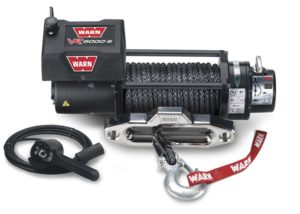
The WARN VR8000-s is the most clearly differentiated choice for someone who prefers synthetic rope. The 87835 version combines an 8,000lb rating with 100ft of Spydura line and a hawse fairlead. Compared with a similar steel line, synthetic rope is lighter and easier to handle when carrying the hook to an anchor point.
The sliding abrasion sleeve is a useful detail where the rope needs protection during a recovery, while the three-stage planetary drivetrain and automatic brake provide the familiar pulling and holding functions. A wired remote keeps operation straightforward. Its limitation is capacity: this is the lowest-rated winch in the group, so a heavier or heavily equipped Jeep can require more. Synthetic rope also needs protection from heat, grit and abrasion; easier handling does not make inspection optional.
Pros
- 100ft Spydura synthetic rope
- Abrasion-protection sleeve and hawse fairlead
- Automatic brake and wired remote
Cons
- 8,000lb rating provides the least capacity margin here
- Synthetic rope requires care around heat and abrasive surfaces
WARN 89120 ZEON 12

The WARN ZEON 12 is the higher-capacity option, with a 12,000lb-rated pull and 80ft of steel wire rope. Its cast-aluminium housing, steel-line roller fairlead and corrosion-conscious finish give it the substantial construction expected of a vehicle-recovery winch. It is worth considering when the vehicle and recovery plan justify more capacity than the smaller models provide.
A convertible control pack adds installation flexibility: it can stay on the winch or be relocated with the appropriate mounting arrangement. That can help when bumper or grille clearance is tight. The steel line and larger package also bring trade-offs in front-end weight and space. Choose the ZEON for the capacity and installation design you actually need, rather than assuming a bigger rating guarantees recovery from every situation.
Pros
- 12,000lb rated line pull
- 80ft steel rope and roller fairlead
- Convertible control pack for mounting flexibility
Cons
- Larger package and steel cable add installation weight
- More capacity may be unnecessary for a lighter vehicle
How to Pick the Best Jeep Winches for the Money
Load Capacity
WARN recommends using the vehicle’s gross vehicle weight rating, or GVWR, multiplied by 1.5 as a starting point for minimum winch capacity. GVWR is the manufacturer’s maximum operating weight, not the empty vehicle’s curb weight. For example, a 5,000lb GVWR gives a starting figure of 7,500lb.
That formula is a selection guide, not a guarantee for every recovery. Slopes, mud, obstacles and rigging change the load. Rated line pull also depends on the line layer on the drum, so more rope wound onto the drum can reduce available pull. Choose capacity and recovery equipment for the vehicle and conditions together.
Steel or Synthetic Rope
Steel Cable
Steel cable offers useful resistance to heat and some abrasive conditions, but is relatively heavy and can develop sharp broken strands or corrosion. It needs inspection, careful handling and the correct fairlead. Use gloves and follow the winch maker’s operating instructions.
Synthetic Rope
Synthetic rope is lighter and easier to handle, making it attractive when moving the hook or managing front-end weight. It still needs protection from grit, sharp edges, abrasion and heat. Keep it clean and remove damaged rope from service; use a manufacturer-approved replacement rather than improvising a repair for a loaded recovery.
Line Length
A longer line can help reach an anchor farther away, but length is not the only consideration. Drum capacity, the required number of remaining wraps and reduced pull on outer layers matter too. Follow the winch’s instructions and use appropriately rated recovery accessories when an extension is required.
Good Reviews
Owner reports are most useful when they identify the exact model and a similar installation. Look for information about mounting clearance, electrical demands, remote operation and parts support. A different rope version or newer generation may have different features even when the brand and nominal capacity look similar.
Detailed Installation Instructions
Check the winch’s mounting pattern, physical dimensions, fairlead position and control-pack clearance against the intended bumper. Confirm the battery, wiring and protection meet the maker’s requirements. Do not assume that a winch suits every Wrangler, JK or TJ simply because it is marketed for Jeeps.
Hardware
Use a rated mount and the specified fasteners, cable sizes and torque settings. A higher fastener grade alone does not establish a correct installation. The mount and recovery points need to be suitable for the loads, and the winch’s instructions should guide the complete setup.
So, What’s the Best Budget Winch for Jeep Wrangler, JK, or TJ?
The Smittybilt 97495 XRC Gen 2 remains the overall recommendation for its 9,500lb rating and well-rounded conventional feature set. The Superwinch LP8500 provides a simpler lower-capacity alternative, the WARN VR8000-s offers synthetic rope, and the ZEON 12 adds more pulling capacity and a flexible control-pack layout.
Choose the model that meets the Jeep’s capacity and installation requirements first. A suitable winch, properly installed and used with the right recovery equipment, is more useful than a bigger specification that does not fit the vehicle or the task.
For the tyre-inflation and onboard-air side of an off-road setup, compare Onboard Air Compressor Kit; it serves a different job from a winch.