The best 110 V MIG welders make small steel repairs and home fabrication more accessible, but the process and power requirements matter as much as the number on the front panel. This group includes gas-shielded MIG machines and simpler gasless flux-core welders. They serve different needs, even though both feed welding wire through a gun.

The five options below suit different approaches to garage and workshop projects. The Hobart Handler 140 is the overall pick for its useful MIG/flux-core capability, straightforward controls and practical wire-drive system. The terms 110 V, 115 V and 120 V commonly appear in this market; follow the exact machine’s input and circuit requirements rather than assuming any household outlet is sufficient.
5 Best 110 V MIG Welders and Flux-Core Alternatives
Pro-Series MMIG125

The Pro-Series MMIG125 is a basic gasless flux-core machine for occasional mild-steel work. Its appeal is simplicity: two heat settings and a wire-feed adjustment give a beginner relatively few controls to learn, and no shielding-gas cylinder is needed for its intended self-shielded wire process. The compact case and included gun, work lead and brush hammer make it a self-contained starting point for small workshop jobs.
The important number is the rated output, not just the 125-amp name. Buffalo’s specification lists 80 amps at a 20% duty cycle, with 125 amps identified as peak current. Its stated mild-steel range runs from 18 gauge to 3/16 inch, but weld quality still depends on preparation, joint design and technique. Thermal-overload protection is a useful safeguard, not permission to ignore cooling time.
The compromises are limited heat adjustment and a flux-core-only workflow. It is not a universal machine for aluminum, copper or every metal in the garage, and it does not offer the cleaner gas-shielded MIG route available on the Hobart. This is also a discontinued consumer model. It makes most sense as a simple existing machine to understand and use within its documented limits, rather than a platform for demanding production work.
Pros
- Simple gasless flux-core setup for mild steel.
- Two heat settings and adjustable wire feed.
- Includes the principal gun and work-lead components.
Cons
- Limited heat adjustment and no gas-shielded MIG capability.
- Discontinued model with a short duty cycle at rated output.
Campbell Hausfeld WF215001AV

The Campbell Hausfeld WF215001AV is another approachable gasless option, with more heat-selection steps than the Pro-Series. Four heat settings work alongside continuously adjustable wire speed, giving the operator two useful ways to match the arc to a small steel project. Its trigger-activated arc also keeps the wire electrically cold until the trigger is pressed.
The steel case and 8-foot torch lead suit a workshop machine that may need moving between jobs. It uses self-shielded flux-core wire, avoiding the cylinder and regulator setup of gas MIG. Thermostatic protection interrupts operation when the unit gets too hot, while the separate wire-speed control allows finer feeding adjustments than a fixed-speed system.
The WF215001AV is designed for flux-core welding rather than gas-shielded MIG. That distinction matters if a smooth, low-spatter finish is the goal. Slag cleanup is part of the process, and this remains a light-duty machine with cooling pauses, rather than an answer to prolonged heavy welding. Its strength is a straightforward set of controls for appropriate small steel jobs.
Pros
- Four heat settings with continuously adjustable wire speed.
- Trigger-activated arc keeps the wire cold until use.
- No shielding-gas cylinder required for its intended process.
Cons
- Flux-core-only design limits process flexibility.
- Slag cleanup and cooling pauses are part of the workflow.
Everlast Power i-MIG 140E

The earlier Everlast Power i-MIG 140E offers a more adjustable approach than a basic tapped transformer welder. Separate, stepless voltage and wire-speed controls let the operator fine-tune the setup instead of moving between a few fixed heat positions. Its IGBT inverter layout also keeps the machine compact, with a bare-unit weight of about 25 pounds in the manufacturer’s specification.
The cast-metal wire-feed mechanism accepts 4- and 8-inch wire spools, while a Euro-style gun connection makes the torch detachable. For an owner moving from a small gasless machine to gas-shielded MIG, those are useful practical features: larger spools can reduce interruptions, and separate controls allow the arc to be adjusted more deliberately. Flux-core use requires the appropriate optional drive rolls.
The trade-off is that the operator must understand those adjustments; it has no Cyclone-style PowerSet screen to select a starting point. The documented output range is 25–140 amps, and Everlast rates it at 25% duty cycle at 140 amps. Suitable gas, wire and optional equipment are still needed for different materials. The analog controls favor an operator who prefers to make those adjustments directly.
Pros
- Stepless voltage and wire-speed adjustment.
- Compact inverter layout with a detachable Euro-style gun.
- Accepts 4- and 8-inch wire spools.
Cons
- Manual adjustment requires more operator judgment.
- Older model; flux-core setup needs suitable optional drive rolls.
Hobart 500559 Handler 140 (Editor’s Choice)
The Hobart 500559 Handler 140 is the most convincing all-round choice here for a compatible home or light workshop setup. It supports both gas-shielded MIG and self-shielded flux-core welding, allowing the owner to choose between a cleaner gas-MIG finish and the convenience of gasless wire. Five voltage positions and a separate wire-feed control keep the setup easy to understand without reducing it to a single fixed operating point.
The industrial cast-aluminum wire drive is a meaningful feature, as is the Quick Select drive roll with grooves for the supported solid and flux-cored wire sizes. A built-in gas valve, dual-gauge regulator and gas hose are included, along with a 10-foot gun and work cable. That gives it a useful foundation for MIG work, although a suitable shielding-gas cylinder must still be supplied.
Hobart specifies a 25–140-amp output range and a rated duty cycle of 20% at 90 amps. Its published steel range reaches from 24 gauge to 1/4 inch, with the correct process and technique; this is not a promise of continuous maximum-output welding. At 57 pounds it is also less convenient to carry than a small inverter. For someone who values a straightforward MIG/flux-core machine over a digital display, however, its control layout and drive system are a strong combination.
Pros
- Supports gas-shielded MIG and self-shielded flux-core welding.
- Cast-aluminum wire drive and Quick Select drive roll.
- Gas valve, regulator, hose and 10-foot gun/work lead included.
Cons
- 57-pound unit is relatively heavy to move.
- Stepped voltage control offers less fine adjustment than a stepless inverter.
Everlast Cyclone 140E
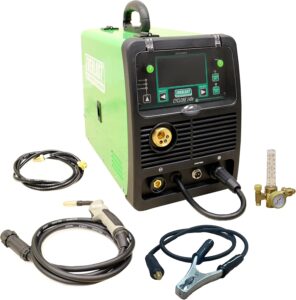
The Everlast Cyclone 140E brings a more modern interface to the compact inverter format. Its LCD shows the settings directly, while PowerSet provides a starting point based on the selected material and wire setup. Manual control remains available, so it can serve both someone learning the relationship between the settings and an operator who prefers to adjust the arc independently.
The 120-volt machine has a 25–140-amp output range, accepts 4- or 8-inch spools and uses a detachable Euro-style MIG gun. Everlast rates it at 25% duty cycle at 140 amps and 60% at 90 amps at 40°C. The useful distinction is its assisted setup and readable display, rather than an assumption that a digital front panel guarantees a better weld.
The standard configuration is not a complete gasless package: Everlast specifies optional drive rolls for flux-core use, and aluminum work calls for the appropriate optional spool gun and consumables. The electrical supply also needs to meet the manufacturer’s requirements for the intended output. For a suitable workshop, the Cyclone offers a current alternative with easier setting visibility and more setup assistance than the earlier analog i-MIG.
Pros
- LCD and PowerSet help establish and repeat settings.
- Stepless manual adjustment remains available.
- Compact inverter design accepts 4- and 8-inch spools.
Cons
- Flux-core drive rolls and an aluminum spool gun are optional.
- Full output requires the specified electrical supply.
How to Pick the Best 110 V MIG Welder
Choose the process for the work, then check the electrical supply, output and consumables. Start with practice pieces and suitable instruction before attempting a repair whose failure could cause injury.
Power Rating
Input voltage and welding output are different specifications. A 120-volt label does not tell you the available welding current or whether a shared household circuit is suitable. Follow the manufacturer’s circuit and connection requirements; have an electrician assess an unsuitable supply rather than modifying a plug or fitting a larger breaker without checking the wiring.
Process Versatility
Gas-shielded MIG and self-shielded flux-core welding both use continuously fed wire, but their gas, polarity, drive-roll and cleanup requirements differ. A flux-core wire feed is not stick welding. Aluminum and stainless work require a machine, wire, shielding gas and feed arrangement appropriate to the material; a generic list of metals is not enough.
Duty Cycle
Compare duty cycle at the stated current and test conditions. A 20% rating at 90 amps means two minutes of arc time within a ten-minute period at that rated output, with the specified cooling interval. It does not mean the same operating time at maximum current. Thermal protection is a backup safeguard, and regularly forcing the machine into shutdown is poor practice.
Convenient to Use
Consider access to the spool, drive roll and polarity connections, along with how clearly the controls communicate their settings. A few heat steps can be approachable, while stepless adjustment gives more control and asks more of the operator. Assisted setup is helpful, but it does not replace clean metal, correct technique and sound joint preparation.
Compact and Portable
Check the bare-machine weight and lead length, then consider the rest of the setup. A shielding-gas cylinder changes portability significantly. Budget for suitable protective equipment, ventilation and consumables, and use the manufacturer’s operating instructions. The home-use welder guide covers additional machine types; this welding overview explains the broader processes.
So, What’s the Best 110 V MIG Welder?
The Hobart 500559 Handler 140 remains the overall pick for its practical MIG/flux-core capability, straightforward controls and useful drive system. The Cyclone 140E is worth comparing if a compact inverter and assisted digital setup are priorities. The simpler flux-core machines serve a narrower role in small steel projects, while the earlier Power i-MIG offers manual inverter control. Match the process and supply to the job before comparing maximum amp numbers.