The best inversion table for a heavy person needs more than a high weight rating. A supportive backrest, manageable ankle restraint and an angle-control system that feels straightforward to use all matter. The six models below cover different combinations of capacity, comfort and adjustment, including options rated above 300 pounds.

The Exerpeutic 975SL remains the overall pick for its 350-pound capacity, air-cushioned ankle supports and adjustable brake control. The alternatives offer different advantages, from a flexible backrest to a heated lumbar pad. Match the exact model’s weight and height limits to the intended user, and obtain medical clearance before using an inversion table.
Best Inversion Tables for Heavy People: Comparison Table
| Image | Model | Max Weight | Max Height | Price |
|---|---|---|---|---|
| Exerpeutic 975SL (Editor's Choice) | 350 lb | 6 ft 6 in | Check Price |
 | IRONMAN Gravity 4000 | 350 lb | 6 ft 6 in | Check Details |
 | Teeter EP-560 | 300 lb | 6 ft 6 in | Check Price |
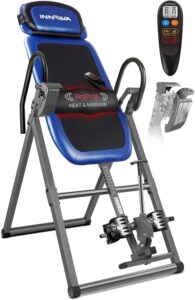 | Innova ITM4800 | 300 lb | 6 ft 6 in | Check Price |
 | Health Gear ITM7.5 | 400 lb | 7 ft | Check Price |
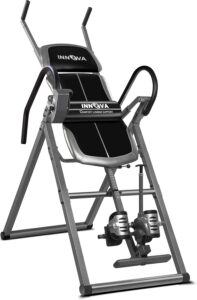 | Innova ITX1200 | 350 lb | 6 ft 6 in | Check Price |
Exerpeutic 975SL (Editor’s Choice)
The Exerpeutic 975SL combines a 350-pound rating with features that address two common frustrations: pressure around the ankles and awkward angle adjustment. Its AIRSOFT ankle cushions use air chambers to spread contact around the legs, while the palm-operated SureLock restraint is designed to make securing the ankles more manageable. A padded backrest and removable lumbar cushion round out a notably comfort-focused design.
The distinctive feature is the iControl disk brake. Instead of relying only on a tether strap to limit the tilt, the user operates a handle to hold the table at the chosen angle. That gives it more flexible positioning than a small set of preset stops. Height adjustment covers users from 4 feet 10 inches to 6 feet 6 inches, and the frame folds for storage.
The brake is a mechanical system that needs the adjustment and maintenance described in the manual; it should not be treated as an automatic safeguard against every movement. The frame also needs clear space when open, and folding does not make a large table effortless to move. Even with those practical considerations, the combination of ankle cushioning, back support and angle control makes the 975SL the strongest all-round choice here for a medically suitable user within its limits.
Pros
- 350-pound rating with a broad height-adjustment range.
- Air-cushioned ankle supports and a removable lumbar cushion.
- Handle-operated brake offers flexible angle positioning.
Cons
- Brake adjustment and maintenance need attention.
- A substantial frame still needs room to use and store.
IRONMAN Gravity 4000
The IRONMAN Gravity 4000 takes a simpler approach: a cushioned backrest, removable lumbar pillow and long handles rather than powered comfort features. The 350-pound version covered here accommodates users up to 6 feet 6 inches. Its padded bed makes it an appealing option for someone who prefers conventional upholstery to a molded, flexible backrest.
Long side handles provide accessible handholds when changing position, while the ankle restraint uses an adjustable locking arrangement. A tether strap limits the tilt, so the chosen setting is established before use rather than selected with a brake handle while inverted. The folding frame helps reclaim floor space between sessions, although the table remains a sizeable piece of equipment.
The main trade-off is that straightforward construction brings fewer convenience features: there is no heated lumbar pad or continuously adjustable brake. Check the rating and instructions supplied with the individual unit, since specifications can differ between versions. The linked manufacturer’s owner manual provides the controls and dimensions for this model; the Gravity 4000 suits someone who values a padded bed and uncomplicated adjustment over electronic extras.
Pros
- Padded backrest and removable lumbar support.
- Long side handles offer useful handholds.
- 350-pound version with a folding frame.
Cons
- Tether adjustment is less flexible than a handle-operated brake.
- Capacity must match the label and manual of the individual version.
Teeter EP-560
The Teeter EP-560 stands apart with its flexible ComforTrak backrest. Rather than using a thick upholstered pad, the contoured bed is designed to flex with movement and provides openings that can accept compatible accessories. Integrated handholds give the user additional places to grip, making the table feel less like a plain padded bench.
Teeter rates the EP-560 for users up to 300 pounds and from 4 feet 8 inches to 6 feet 6 inches. Its ankle cups wrap around the ankles, and the adjustable foot platform helps position the feet. The ankle restraint uses a T-pin arrangement, while a tether strap limits the angle. The frame can be folded when the table is not in use.
The 300-pound limit is the important boundary: this is not an option for someone above that rating, however substantial the construction looks. The molded bed also gives a different feel from the foam-padded models, and the T-pin restraint is less reach-friendly than a long locking handle. For a suitable user who prefers flexibility, handholds and a less heavily upholstered surface, the EP-560 offers a distinctive alternative.
Pros
- Flexible ComforTrak backrest with integrated handholds.
- Accommodates users as short as 4 feet 8 inches.
- Adjustable foot platform and wrapping ankle cups.
Cons
- 300-pound maximum excludes heavier users.
- Molded bed and T-pin restraint will not suit every preference.
Innova ITM4800
The Innova ITM4800 adds a heated, vibrating lumbar pad to an otherwise practical padded table. The pad offers multiple operating modes and can be positioned around the lower-back area, giving this model a comfort feature that the simpler tables lack. It is a warmth-and-vibration accessory, not a substitute for medical treatment or proof that inversion is appropriate for a particular back problem.
A six-position pin system establishes the angle limit before use, with a protective cover over the adjustment area. The adjustable headrest and height setting help balance the table for the user. Current US versions also have an extended ankle-holder handle, which reduces how far the user needs to reach compared with the earlier short arrangement.
The manufacturer specifies a 300-pound maximum and a height range of 4 feet 10 inches to 6 feet 6 inches. That makes it a comfort-oriented choice within the lower end of this roundup’s capacity range rather than a table for users above 300 pounds. The pad adds an electrical component and cord to manage, while the preset pin system offers defined positions instead of the 975SL’s more flexible brake control.
Pros
- Positionable lumbar pad with heat and vibration modes.
- Six-position angle-limit system.
- Current US ankle holder has an extended handle.
Cons
- 300-pound rating is lower than several alternatives.
- Powered lumbar pad adds a cord and electrical components.
Health Gear ITM7.5
The Health Gear ITM7.5 has the highest stated capacity and height allowance in this group: 400 pounds and up to 7 feet, according to its model specifications. Those limits make it particularly relevant to a larger or taller user who would exceed the ratings of several other tables. Its thick foam backrest and adjustable headrest give it a more generously padded feel than a molded-bed design.
The removable lumbar pad provides heat and vibration, controlled by a handheld remote. The Sur-lock ankle restraint uses an extended locking arm, and the table offers preset angle settings of 20, 40 and 60 degrees. Built-in wheels and a folding frame make repositioning and storage more manageable, although neither feature turns it into a lightweight piece of equipment.
The appeal is the combination of generous model-specific limits, padding and powered comfort features. The limitations are the substantial footprint and reliance on preset angles rather than continuously variable brake control. Match the ITM7.5 identification and rating to the actual unit, and retain its instructions; a high capacity alone does not establish that a table is medically suitable for its user.
Pros
- Model specifications allow up to 400 pounds and 7 feet.
- Thick backrest padding and remote-controlled lumbar heat and vibration.
- Extended ankle-locking arm, folding frame and transport wheels.
Cons
- Large frame requires substantial clear floor space.
- Three preset angles offer less fine adjustment than a brake system.
Innova ITX1200
The Innova ITX1200 is a useful choice when a 300-pound table is not enough and powered lumbar features are not a priority. Its 350-pound rating is paired with a padded backrest, lumbar support and an extended ankle-holder handle. Height adjustment covers users from 4 feet 10 inches to 6 feet 6 inches, giving it a clearly defined place alongside the 975SL.
The most distinctive addition is the pair of adjustable stretch bars above the headrest. These provide an extra hand position, while the headrest and height adjustments form Innova’s two-part balance setup. A three-position pin system limits the tilt, with a protective cover over the adjustment mechanism. The reversible ankle-holder arrangement offers another way to adjust the contact around the lower legs.
The ITX1200 keeps the focus on support and adjustment rather than a heat-and-vibration pad. Its three angle settings are fewer than the ITM4800’s six, so someone who values closely spaced preset positions may prefer that model if its lower capacity is sufficient. For a medically suitable user seeking a 350-pound table with extended controls and additional hand positions, the ITX1200 is a well-defined, practical alternative.
Pros
- 350-pound rating and an extended ankle-holder handle.
- Adjustable stretch bars add a hand position.
- Padded backrest, lumbar support and reversible ankle holders.
Cons
- Three preset angle limits rather than six or continuous brake control.
- No powered heat-and-vibration lumbar pad.
Choosing an Inversion Table for a Heavy Person
Start with the Exact Weight and Height Limits
Use the manufacturer’s limit for the specific model and version, not a general claim about the brand. The tables above range from 300 to 400 pounds, and their height adjustments differ too. A stronger frame does not correct an unsuitable ankle fit or make inversion appropriate for every user.
Compare Ankle Restraints and Angle Controls
The ankle supports carry pressure during inversion, so their shape, padding and adjustment deserve close attention. An extended locking handle can reduce the reach needed to secure the restraint. For angle control, decide whether a tether, preset pin or handle-operated brake seems most manageable, and learn the exact procedure before use.
Choose Comfort Features for a Reason
A padded bed, flexible molded backrest and heated lumbar pad offer different experiences. Extra padding is not automatically better for every body shape, and heat or vibration does not establish a therapeutic benefit. Prioritize fit and usable controls before choosing an accessory.
Allow Space and Follow the Medical Guidance
Measure the clear operating area as well as the folded dimensions. Folding helps with storage but does not remove the need to move a heavy frame. Inversion changes the demands on the body and is unsuitable for some medical conditions. Obtain medical clearance, read the manufacturer’s contraindications and follow the instructions for the actual unit rather than a generic inversion routine.
Best Inversion Table for a Heavy Person: Final Thoughts
The Exerpeutic 975SL earns the overall recommendation for its combination of a 350-pound rating, air-cushioned ankle supports and handle-operated brake. The Innova ITX1200 offers another 350-pound option with stretch bars and extended ankle controls, while the Health Gear ITM7.5 has the broadest stated weight and height allowance. Within a 300-pound limit, the Teeter EP-560 offers a flexible backrest and the Innova ITM4800 adds a heated, vibrating lumbar pad. Choose the model that fits the user and the available space, with medical suitability established first.