The best elliptical machine for a heavy person needs a suitable weight rating, comfortable pedal motion and enough room for the full stride. The four models below take different approaches, from a feature-rich front-drive trainer to a simpler manually adjusted machine. The SOLE E95 supports up to 400 pounds; the three other models have 300-pound limits.
If you prefer a seated cycling workout, compare the guide to recumbent exercise bikes for heavy people before choosing the exercise format.
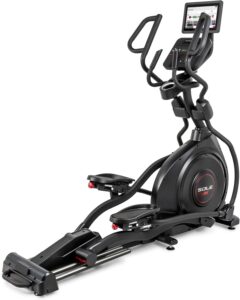
The E95 is the overall pick for someone who needs the higher capacity and wants powered incline with a modern console. Within a 300-pound limit, the Schwinn 470 adds motorized incline, the 430 keeps the ramp adjustment manual, and the Exerpeutic 1000XL favors straightforward controls. Compare the movement and usable floor space as carefully as the screen or program list.
Best Ellipticals with High Weight Capacity: Comparison Table
| Image | Model | Weight Capacity | Price |
|---|---|---|---|
 | Schwinn 470 | 300 lb | Check Price |
| SOLE E95 (Editor's Choice) | 400 lb | Check Price |
 | Schwinn 430 | 300 lb | Check Price |
 | Exerpeutic 1000XL 1302 | 300 lb | Check Details |
SOLE E95 (Editor’s Choice)
The SOLE E95 is the most capable option here for a user who needs a capacity above 300 pounds. The current E95 has a 400-pound rating, a 20-inch stride and a 27-pound flywheel. Its front-drive layout and substantial steel frame make it a machine to plan a permanent space for, rather than something to fold away after each session.
Twenty levels of magnetic resistance and 20 levels of powered incline provide two ways to vary the workout. Controls on the multi-position grips make those changes accessible while exercising, while the cushioned pedals offer multiple angle settings to help tailor the stance. The 13.3-inch touchscreen swivels and tilts, and the console includes Bluetooth speakers and USB-C charging.
The E95’s appeal is the combination of capacity, adjustable pedal setup and powered workout controls. Its limitations are size and weight: the current frame is roughly 83 inches long and 34 inches wide, with a delivery and assembly job to match. Choose it when the higher load rating and fuller feature set suit the intended routine and the room can accommodate the complete machine.
Pros
- 400-pound rating and a 20-inch stride.
- Twenty levels each of magnetic resistance and powered incline.
- Adjustable cushioned pedals and a swiveling 13.3-inch touchscreen.
Cons
- Large, non-folding frame needs a permanent operating area.
- Substantial weight makes delivery and assembly worth planning.
Schwinn 470
The Schwinn 470 offers a useful combination of a 20-inch stride, 25 resistance levels and motorized incline. Its 300-pound maximum is the first limit to consider: this is a different capacity class from the E95, even though the console and workout choices are extensive. Within that limit, it gives a home user several ways to vary a session.
The powered ramp adjusts through a 10-degree range, and the DualTrack blue-backlit displays provide workout feedback with 29 built-in programs. Moving and fixed handlebars offer different hand positions, while the media shelf, fan and USB charging add everyday convenience. Bluetooth is included, but the availability of particular third-party apps should be checked separately from the machine’s built-in programs.
The 470 suits someone who values console-controlled incline and plenty of preset variety without requiring a large touchscreen. It is still a full-size, non-folding home trainer, and the stride should be tried for comfort rather than assumed to suit every user. The program range and powered ramp are its practical advantages; neither changes the 300-pound limit.
Pros
- Twenty-inch stride with 25 resistance levels.
- Motorized 10-degree ramp and 29 built-in programs.
- DualTrack backlit feedback, media shelf and USB charging.
Cons
- 300-pound maximum excludes users above that rating.
- Full-size, non-folding frame and app availability need consideration.
Schwinn 430
The Schwinn 430 keeps much of the familiar full-size elliptical layout while taking a simpler approach to incline. It has a 20-inch stride, 20 computer-controlled resistance levels and a manually adjusted ramp. Its 300-pound rating matches the 470, making the choice between them more about controls and workout variety than load capacity.
The DualTrack display system and built-in programs provide ordinary session feedback without a large connected screen. Goal tracking lets the user compare exercise totals, and the USB charging port is useful when a phone or music player is nearby. Moving and fixed handlebars provide a choice of grip positions, while the cushioned footplates support the standing stride.
The six-position ramp is adjusted manually, so it is better suited to choosing an incline before a session than changing it repeatedly during intervals. The 430 also needs a dedicated floor area and adequate headroom above the user at the top of the pedal movement. Choose it when the long stride and computer-controlled resistance matter more than powered incline or a touchscreen.
Pros
- Twenty-inch stride and 20 resistance levels.
- DualTrack feedback and built-in workout programs.
- Six-position manual ramp, cushioned footplates and USB charging.
Cons
- Incline is adjusted manually.
- 300-pound limit and non-folding frame need to suit the user and room.
Exerpeutic 1000XL 1302
The Exerpeutic 1000XL 1302 is the straightforward option for someone who prefers a manual tension control and a basic workout display. Its manufacturer’s manual specifies a 300-pound maximum user weight. The separate moving arms and fixed handlebar give it a conventional standing elliptical layout without a large powered console dominating the front.
The tension knob changes the load mechanically, while the LCD cycles through ordinary feedback such as time, speed, distance and calories. It also allows goal values to be set and counts down toward them. Hand-pulse sensors are fitted to the stationary handlebar; the readouts are useful session references rather than medical measurements.
The trade-off is a simpler control and feedback system. There is no powered incline or menu of automatically changing resistance programs, and the pedal motion is worth trying before choosing. Adjustable rear stabilizer caps help level the trainer on a suitable floor. The 1302 makes sense when uncomplicated controls are the priority, with assembly and routine checks followed as described in its owner manual.
Pros
- 300-pound rating and manually adjusted tension.
- Basic LCD feedback with goal-value countdowns.
- Moving arms, fixed pulse-sensor handlebar and adjustable stabilizer caps.
Cons
- No powered incline or automatic resistance programs.
- Basic console and pedal motion may not suit every preference.
Types of Elliptical Machines for Big Men and Women
A front-drive elliptical places the resistance system ahead of the pedals, while a rear-drive design places it behind them. Center-drive and compact layouts arrange the mechanism differently to change the footprint and feel. A hybrid combines more than one exercise position. These categories describe the layout, not a guarantee of stability, comfort or suitability for a particular body size.
How to Pick the Best Elliptical Machine for Heavy People
Weight Rating and Pedal Fit
Start with the exact model’s maximum user weight. In this comparison, the E95 is rated for 400 pounds and the other three for 300 pounds. Check the stride, pedal spacing, grip reach and ability to mount the machine comfortably. A higher rating does not establish that the movement will suit every user.
Console and Workout Controls
Decide whether a touchscreen and connected features will be used regularly or whether ordinary session feedback is enough. Built-in programs remain a different feature from third-party app access. Hand-pulse readings and calorie estimates are exercise references, not medical measurements or guaranteed results.
Resistance and Incline
Resistance changes the effort of the stroke, while an incline ramp changes the pedal path. Powered adjustment is convenient for frequent changes, whereas a manual ramp may be sufficient when one setting is used for most of a session. A larger flywheel is only one part of the complete design.
Shape, Size and Headroom
Measure the frame and the space needed around the moving pedals and handles. Ceiling clearance needs to account for the user standing on a raised pedal, including the highest incline setting. None of these models should be assumed to fold or dismantle easily for daily storage. The broader elliptical-trainer layout is worth understanding before planning the room.
Assembly, Maintenance and Warranty
Check the delivery path and the help required for assembly before choosing a large trainer. Keep rails and moving contact areas clean, inspect fixings and follow the individual manual. Warranty coverage depends on the model, seller, region and terms; it should be read rather than treated as a promise that every repair will be free.
Budget
Set the budget around the features that will actually be used, including delivery and assembly where needed. A higher-capacity frame and comfortable movement matter more than paying for console functions that do not suit the intended routine.
Best Elliptical Machine for a Heavy Person: Final Thoughts
The SOLE E95 earns the overall recommendation for its 400-pound rating, adjustable pedals, powered incline and current touchscreen console. The Schwinn 470 offers powered ramp control within a 300-pound limit, while the 430 favors a simpler manual ramp. The Exerpeutic 1302 keeps controls basic. Choose the right load rating first, then the stride, space requirements and features that fit the user.